Hair is Never Just Hair
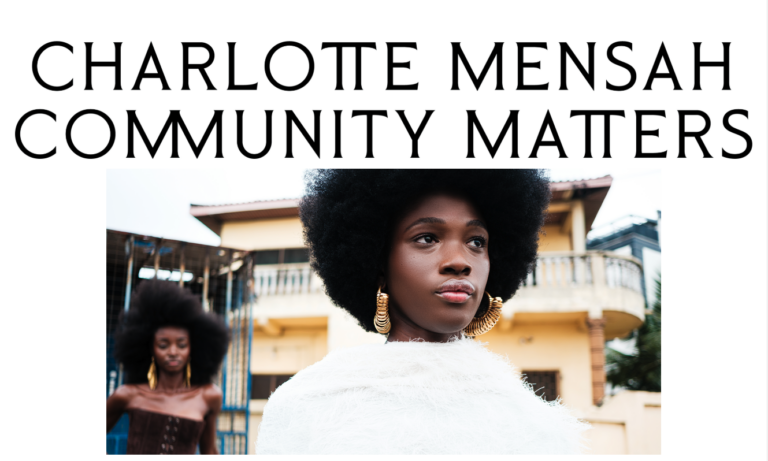
At Charlotte Mensah: Community Matters, currently at Ladbroke Hall in London, hair is treated as far more than appearance. The mixed-media retrospective marks Mensah’s 40 years in hairdressing through photography, film, archival material, sound and personal objects, tracing how Afro and textured hair can carry identity, craft, entrepreneurship and community.
The exhibition invites us to look beyond the finished hairstyle to the relationships and histories surrounding it. Biology offers a surprisingly similar invitation: look beneath the visible strand, and hair becomes a story about a living community of cells.
Beneath the Strand Is a Living Organ
A hair shaft may look like a simple fibre, but the follicle that produces it is a dynamic mini-organ. Its development and regeneration depend on coordinated interactions between epithelial and mesenchymal cells, stem-cell populations, signalling pathways and the surrounding extracellular environment.
Recent research from Johns Hopkins University (Asami S, Yin C, Fan J, Garza LA, Kalhor R., 2026) states that organisation visible in remarkable detail. Using deep-tissue spatial transcriptomics, researchers mapped hundreds of developing hair follicles in neonatal mouse skin and reconstructed their progression through developmental time. The study revealed the gradual organisation of stem-cell compartments, emergence of new cellular subtypes and structural changes that eventually produce a functioning follicle.
What appears above the skin is therefore only the final expression of a much richer process underneath.
When “Community” Becomes Biological
This is where organoids become particularly useful.
Researchers at Peking Union Medical College Hospital recently followed hair-follicle formation within human iPSC-derived skin organoids, using spatial proteomics to examine stages from early hair-germ formation through follicular maturation. Different developmental stages showed distinct molecular programmes, including changes associated with extracellular-matrix organisation and keratinisation.
Rather than isolating one cell population, such models preserve enough multicellular organisation for researchers to study how a follicle develops as a system.
That context can also support functional testing. A 2026 study created embryonic-stem-cell-derived hair-bearing organoids and exposed them to dihydrotestosterone (DHT) to model features of androgenetic alopecia. DHT reduced pigmented follicles and hair-growth-associated markers; treatment with minoxidil or a soybean embryo extract partially restored these measures.
These models are still simplified. They do not reproduce the complete diversity of human scalp tissue, circulation, immune activity, ageing or systemic hormonal influences. But they move hair research away from isolated cells towards experimentally tractable tissue context.
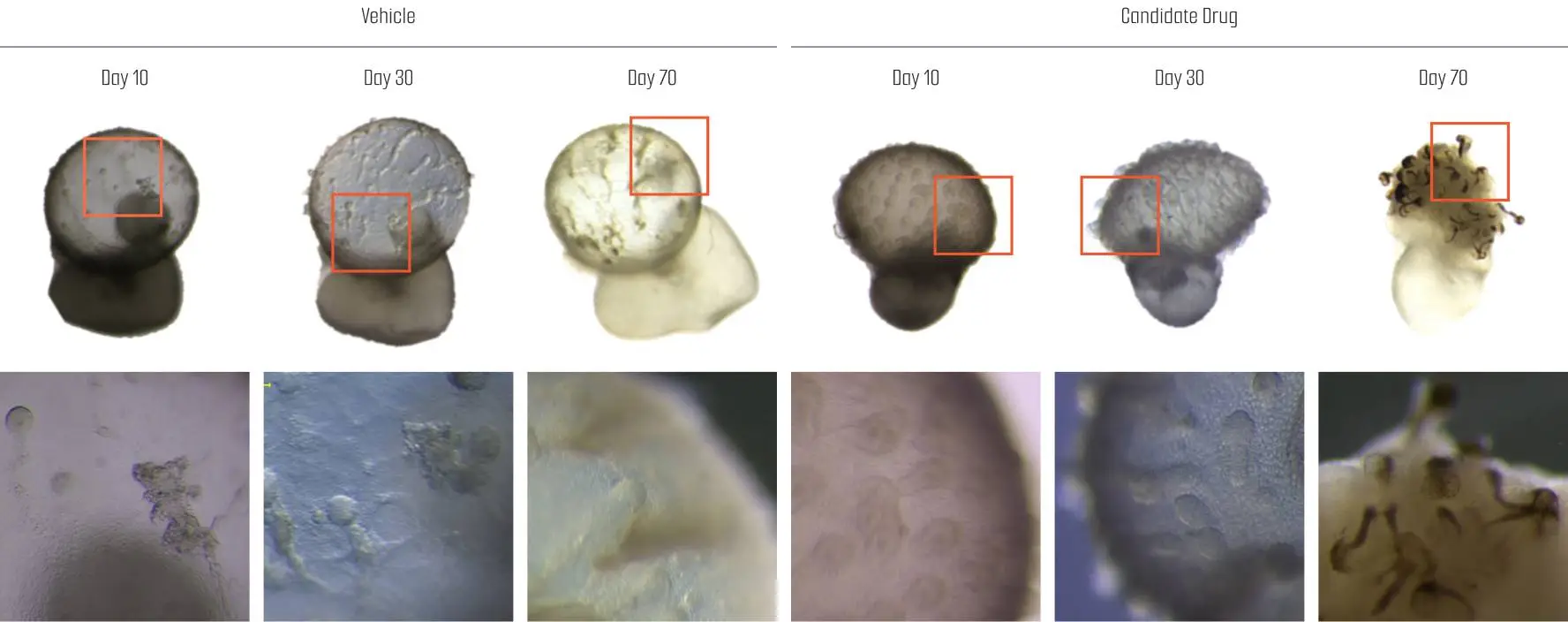
Skin & Hair Organoids
Advance Drug Discovery with Smarter, Ethical Models
Looking Beyond the Surface
Community Matters shows that understanding hair means looking beyond the strand to the people, histories and relationships around it.
Biotechnology is beginning to make a comparable move beneath the skin. The closer researchers look at the follicle, the clearer it becomes that hair is not produced by one cell or one signal, but by coordinated biological relationships.
In culture as in biology, community matters.
References
- Charlotte Mensah. Charlotte Mensah: Community Matters. Ladbroke Hall, London; 8–13 September 2026.
- Asami S, Yin C, Fan J, Garza LA, Kalhor R. Four-dimensional molecular mapping from a spatial snapshot reveals the dynamics of hair follicle organogenesis. Cell. 2026. doi:10.1016/j.cell.2026.06.014.
- Liang L, Zhou J, Wang W, Wang W, Liu Y, Li J, Leng L. Spatially Resolved Proteomic Mapping in Skin Organoid for Hair Follicle Development. Molecular & Cellular Proteomics. 2026;25(1):101482. doi:10.1016/j.mcpro.2025.101482
- Kyung S, Lim SJ, Lee KE, et al. Exploring the efficacy evaluation model for androgenic alopecia using hair organoids: Transcending conventional hair research. Journal of Dermatological Science. 2026;122(3):86–93. doi:10.1016/j.jdermsci.2026.04.001