Ageing on Display
At Wellcome Collection on Euston Road, a silver sake cup greets visitors. Japan gives one to every citizen who turns 100; as the number of centenarians rose, the cups were made from a cheaper alloy. It is a fitting start to The Coming of Age (26 March – 29 November 2026, free), which brings together more than 120 artworks and objects to ask how environment, culture and society shape the way we grow older.
The show moves from adolescence to later life. Charles Darwin’s walking stick sits near a 17th-century jar for “syrup of life”. Elinor Carucci’s photograph Grey Hair Sticking Straight Up (2015) looks frankly at a body starting to change. Paula Rego’s pastel self-portraits, made after a bad fall at 81, show a bruised and swollen face. Most affecting are William Utermohlen’s self-portraits made after his Alzheimer’s diagnosis in 1995: over the years the perspective slips and the features dissolve, until the face is barely there.
Time, Written in Tissue
For anyone who works with organoids, the exhibition raises an awkward question about our own tools. Organoids grown from pluripotent stem cells follow developmental programmes, so they usually resemble foetal tissue more than adult tissue. That makes them excellent for studying how organs form, and weaker for studying the conditions that fill so much of this exhibition: dementia, greying hair, an ageing body. Alzheimer’s develops over decades; most organoid experiments last months.
Keeping Time in a Dish
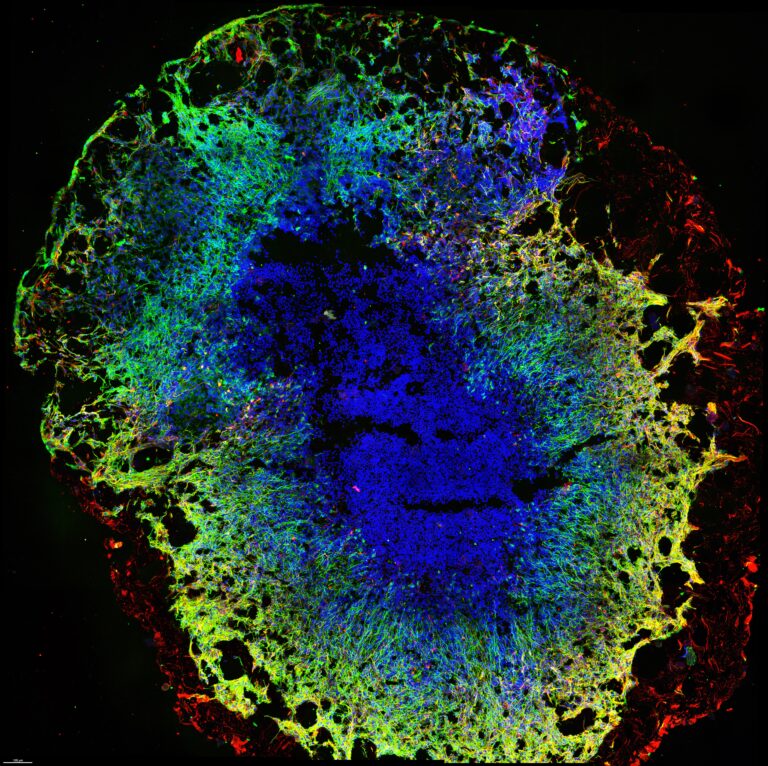
That gap is starting to narrow. In August 2026, Faravelli and colleagues reported in Nature that they had kept human cortical organoids in culture for more than five years. Over that time the organoids took on gene-expression patterns, neuron types and dendritic spines resembling the late-prenatal and postnatal brain, and their DNA-methylation “age” rose in step with time in culture. When progenitors from old and young organoids were mixed, the older cells skipped ahead and produced late-born neurons in about two weeks instead of two months: an internal clock that survives a move into a younger neighbourhood.
A second approach brings disease in from outside. Ji and colleagues (2025) built vascularised brain organoids containing immune cells, then exposed them to brain extracts from people with sporadic Alzheimer’s disease. The organoids developed several hallmarks of the disease, including amyloid and tau pathology: a human system in which the material that drives the disease, not just its genetic risk, can be tested against drugs.
Brain Organoids
Advance Drug Discovery with Smarter, Ethical Models
The Colour of Time
Carucci’s grey strands point to a different clock. Hair colour depends on melanocyte stem cells in the follicle, and skin organoids are beginning to model this pigment unit. Li and colleagues (2025) rebuilt pigmented, hair-bearing skin from skin organoids and identified collagen VI and semaphorin 3C signals that keep melanocytes alive and guide them to the right place in the follicle, the kind of question Lambda’s Skin & Hair Organoid is built to explore in human tissue.
What a Dish Cannot Hold
Some humility is needed. Five years in culture is still not seventy. Methylation clocks are a proxy for ageing, not ageing itself. None of these models recreates the systemic forces the exhibition puts at its centre: circulation, hormones, a lifetime of immune history, sunlight, stress and care. Organoids that age on demand would be a powerful tool, but they would model parts of ageing, not the whole of a lived life.
The Coming of Age insists that ageing is shaped by the world around us as much as by our cells. Organoids, slowly learning to keep time, are teaching the cellular side of the same lesson: age is not simply a number, but a record of everything a body has been through.
References
- Wellcome Collection. The Coming of Age. London; 26 March – 29 November 2026.
- Faravelli I, Antón-Bolaños N, Wei A, et al. Human brain organoids record the passage of time over multiple years. Nature. 2026. doi:10.1038/s41586-026-10877-x
- Ji Y, Chen X, Wang Z, et al. Alzheimer’s disease patient brain extracts induce multiple pathologies in novel vascularized neuroimmune organoids for disease modeling and drug discovery. Molecular Psychiatry. 2025;30(10):4558–4575. doi:10.1038/s41380-025-03041-w
- Li T, Li X, Xiang X, et al. Regenerative hair pigmentation via skin organoids: adaptive patterning mediated by Collagen VI and Semaphorin 3C. Advanced Science. 2025;12(36):e02436. doi:10.1002/advs.202502436