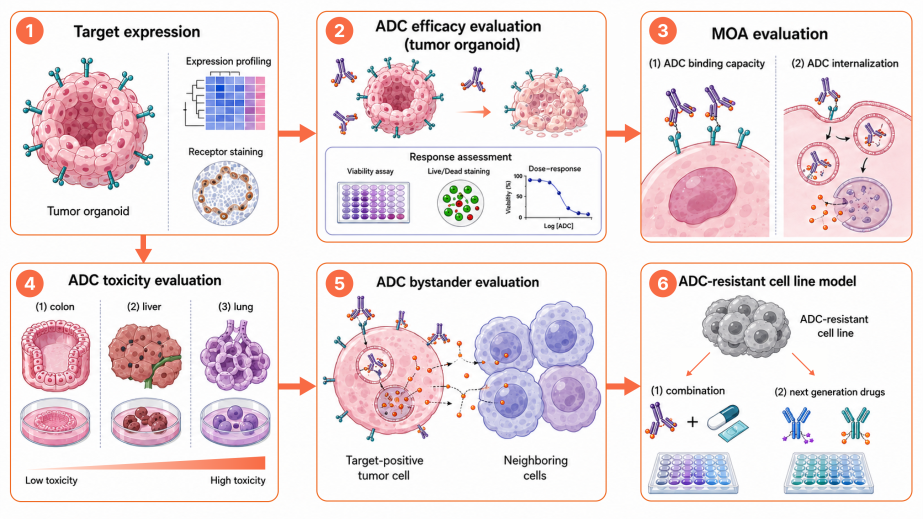
Lambda Biologics’ organoid-based ADC evaluation workflow supports multiple stages of preclinical ADC development, from target expression profiling and tumor efficacy assessment to MOA analysis, toxicity evaluation, bystander effect testing, and ADC-resistance model development. By integrating patient-relevant tumor and normal organoid models, this platform helps generate more predictive insights into ADC efficacy, safety, and therapeutic potential.
Antibody-drug conjugates, or ADCs, are targeted cancer therapies that combine a monoclonal antibody, a chemical linker, and a cytotoxic payload. The antibody binds to a tumor-associated antigen and helps deliver the payload more selectively to cancer cells. ADC performance depends on factors such as target expression, internalization, linker stability, payload release, tumor heterogeneity, bystander effect, resistance, and normal tissue toxicity, making human-relevant preclinical models important for ADC evaluation. The FDA’s ADC clinical pharmacology guidance also frames ADC development around cytotoxic small-molecule payloads and related bioanalytical, exposure-response, dosing, and safety considerations.
As of June 2026, the FDA-approved ADC landscape continues to expand across solid tumors and hematologic malignancies. Recent FDA activity includes Datroway / datopotamab deruxtecan-dlnk for HR-positive/HER2-negative breast cancer, EGFR-mutated NSCLC, and triple-negative breast cancer; Emrelis / telisotuzumab vedotin-tllv for c-Met–high non-squamous NSCLC; Blenrep / belantamab mafodotin-blmf for relapsed or refractory multiple myeloma; and Decnupaz / pivekimab sunirine-pvzy for BPDCN.
ADC target expression can be assessed before efficacy testing using transcriptomic, protein-level, and spatial profiling methods. Common approaches include RNA-seq, FACS/flow cytometry, immunostaining, and spatial profiling to help identify suitable PDO, PDO-CAF, PDOX-CAF, tumor organoid, and normal organoid models for antibody-drug conjugate evaluation.
Target expression pre-screening is especially important for ADC studies because antigen abundance, expression heterogeneity, and tumor-versus-normal selectivity can strongly influence ADC response. By selecting models with target-high, target-low, and heterogeneous expression patterns, researchers can better evaluate whether ADC activity correlates with antigen level and identify the most informative models for efficacy, toxicity, and resistance studies.
At Lambda Biologics, target expression assessment can be integrated with organoid model selection to support more rational ADC study design and reduce the risk of uninformative preclinical testing.
The ADC bystander effect can be evaluated using tumor–stromal co-culture organoid systems, such as tumor organoid–CAF models. In these models, tumor cells and cancer-associated fibroblasts can be separately labeled or detected using cell-specific fluorescent markers, lineage markers, imaging-based segmentation, or flow-based readouts.
This enables individual quantification of tumor-cell killing and CAF apoptosis, helping distinguish direct target-mediated ADC cytotoxicity from bystander payload effects. Relevant endpoints may include cell viability, apoptosis markers, caspase activation, DNA damage response, and spatial distribution of affected cells within the co-culture system.
ADC efficacy and normal tissue toxicity can be assessed side by side by comparing drug response in tumor organoids and relevant normal organoid models. Tumor organoids are used to evaluate anti-tumor activity, while normal organoids help assess tumor selectivity, on-target/off-tumor effects, payload-related toxicity, and therapeutic window.
Depending on the ADC target and payload class, normal organoid models may be selected from tissues with expected clinical relevance, such as colon, liver, lung, skin, or other epithelial tissues. Endpoints can include viability, apoptosis, morphology, tissue-specific damage markers, antigen expression, and dose-response sensitivity.
This tumor-versus-normal comparison helps determine whether an ADC shows preferential activity against cancer models while maintaining reduced toxicity in normal human-relevant systems. Lambda Biologics applies this organoid-based approach to support ADC candidate prioritization and translational risk assessment.
Extended culture protocols are recommended when ADCs carry payloads with delayed pharmacodynamic effects, such as topoisomerase I inhibitor-class payloads, also known as TOP1i payloads. A standard short-term assay window, such as 3–5 days, may not fully capture delayed DNA damage response, cell-cycle arrest, apoptosis induction, or time-dependent cytotoxicity.
For TOP1i-class ADCs, assay duration can be adjusted based on organoid growth kinetics, model stability, dosing schedule, payload mechanism of action, and endpoint requirements. Extended protocols may support more accurate assessment of delayed tumor killing, residual viable cell populations, post-treatment regrowth, and early resistance-associated phenotypes.
Dual-payload ADCs can be evaluated using comparative organoid studies that include single-payload ADCs, unconjugated antibody controls, free payload controls, isotype ADC controls, and standard treatment references. For colorectal cancer and other solid tumor studies, the model panel should ideally include target-high, target-low, and heterogeneous-expression organoids to assess whether the dual-payload design provides broader or stronger activity across biologically diverse tumors.
Key readouts may include dose-response curves, IC50/EC50, maximum killing effect, apoptosis, DNA damage response, target expression–response correlation, and post-treatment residual cell analysis. These studies can support ADC candidate ranking, mechanism-of-action analysis, resistance exploration, and translational decision-making. However, organoid data should be positioned as a human-relevant preclinical indicator, not as a standalone predictor of clinical superiority.
Specialized organoid-based assays for modeling human biology in vitro—designed to enhance predictive accuracy in drug response, toxicity, and disease progression.
Custom in vitro studies leveraging organoid and cell-based models to support hypothesis-driven research, mechanistic validation, and translational insights.
Advanced analytical support including molecular profiling, spatial biology, and imaging—enabling precise characterization of organoid and cell-based systems.
We use cookies that are necessary to make our site work. We may also use additional cookies to analyze, improve, and personalize our content and your digital experience. You can manage your cookie preferences using the Cookie settings link. For more information, see our Privacy Policy




