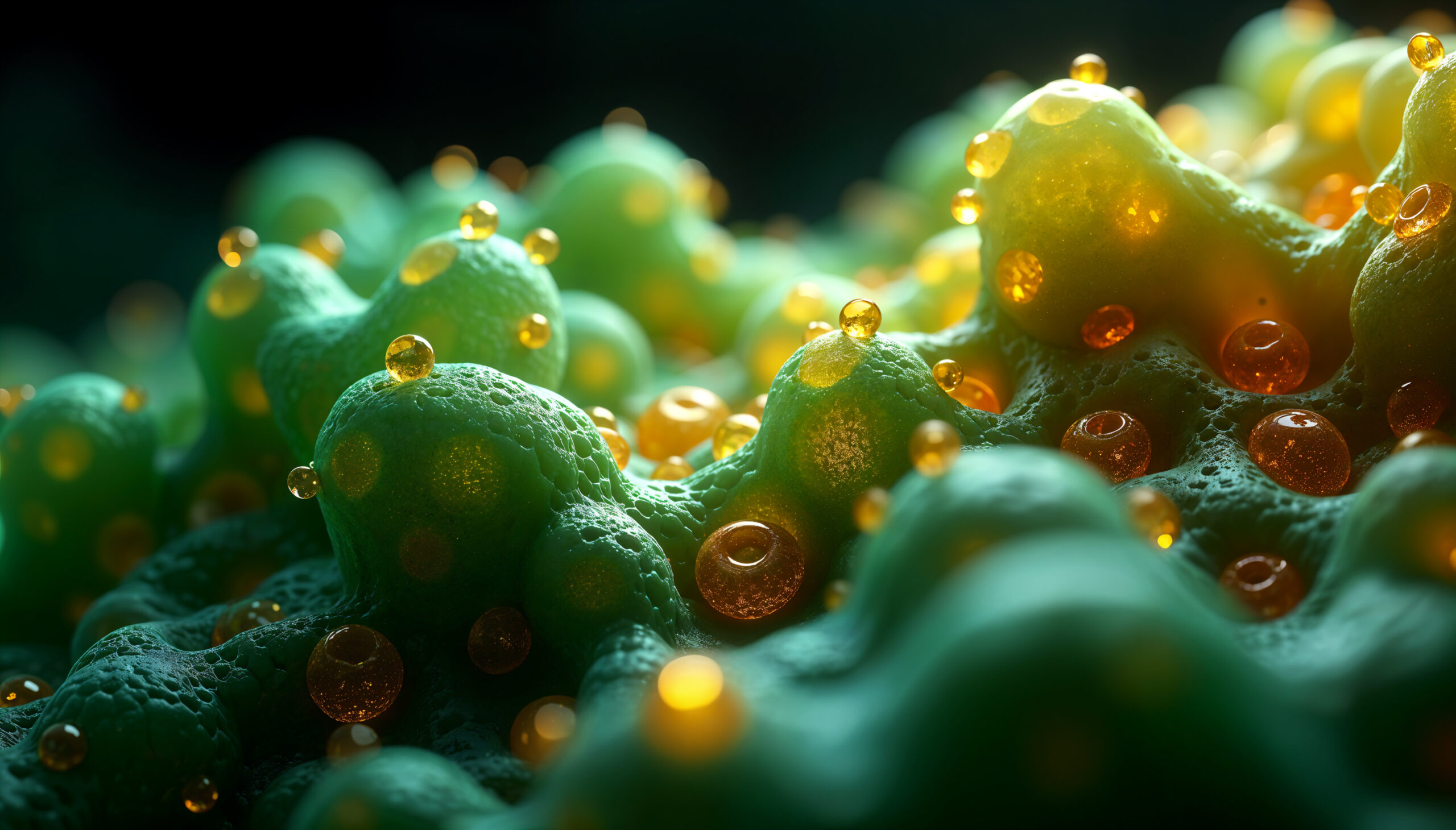
Martin Oeggerli’s microscopic images reveal the human body as an intricate habitat. Emerging microbiome research is taking a similar ecological view, moving from cataloguing microorganisms toward understanding—and experimentally modelling—the relationships between microbes and human tissues.
Landscapes Beneath the Skin
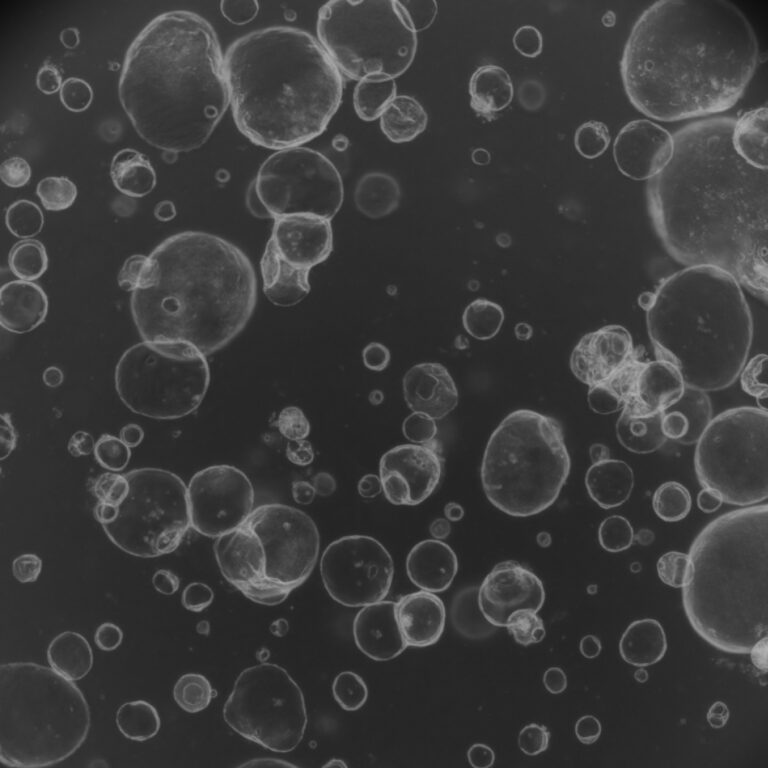
At the Novartis Pavilion in Basel, Martin Oeggerli’s exhibition You Are a Coral Reef: The Microcosms of the Human Body asks visitors to see themselves at an unfamiliar scale. Across eighteen works, the Swiss molecular biologist and science photographer uses scanning electron microscopy, extreme magnification and hand colourization to transform sperm cells, skin, intestinal bacteria, muscle fibres and neurons into landscapes that appear almost planetary.[1]
The exhibition, running from 16 June to 30 August 2026, presents the human body not as an isolated object, but as an interconnected environment populated by cells and microorganisms.
Seen closely enough, the body begins to look less like a single organism and more like a habitat.
The Body as Habitat
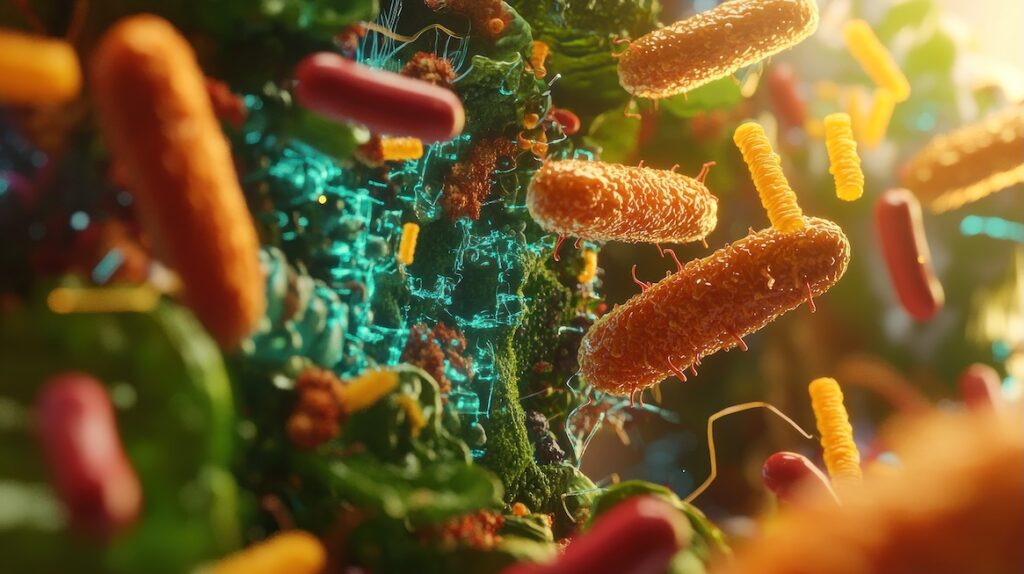
The metaphor is especially powerful in the gut. Here, microbial communities live alongside mucus, nutrients and epithelial tissue, generating metabolites and interacting with one another as well as their human host.
The important question is therefore no longer simply which microbes are present. Like species within a coral reef, their behaviour depends on relationships, resources and neighbouring organisms.
This ecological view is changing microbiome research. Instead of treating individual bacterial species as isolated actors, researchers are increasingly asking how communities assemble, cooperate and compete—and whether those relationships can be deliberately shaped.
From Counting Microbes to Designing Communities
A 2026 Nature Chemical Biology study illustrates this shift. Connors, Thompson and colleagues combined high-throughput microbial experiments with machine learning and Bayesian optimization to search for combinations of dietary fibres and gut bacteria that produced desirable community functions.[2]
Their design–test–learn system identified a combination involving inulin, Bacteroides uniformis and Anaerostipes caccaethat promoted butyrate production, with additional effects involving Prevotella copri. Designed combinations were subsequently tested in human faecal microbial communities.[2]
The study does not imply that microbiomes can yet be engineered with complete predictability. Microbial ecosystems remain highly variable between individuals and contain interactions far more complex than simplified laboratory communities.
But the conceptual change is significant. Oeggerli’s photographs invite us to notice the microorganisms themselves; emerging biotechnology asks a harder question: what happens between them?
Where the Reef Meets the Body
A microbial ecosystem, however, is only half of the story. The habitat itself responds.
Researchers are therefore developing experimental systems that bring human tissue and microbes together. In 2026, a study of paediatric inflammatory bowel disease generated intestinal organoids and cultured mucosa-associated bacteria from corresponding patient biopsies.[3]
Using microinjection, the researchers introduced selected bacteria into the organoid lumen, allowing microorganisms to encounter the apical surface of patient-derived intestinal epithelium. Closely related bacterial isolates produced different epithelial responses, including differences in inflammatory signalling and intestinal permeability.[3]
The study involved a limited number of tested isolates and organoid lines, but it demonstrates how patient-derived models can begin to examine host–microbe relationships that are difficult to isolate within the human body.
Organoids cannot reproduce the complete immune, vascular and microbial complexity of a living intestine. Their usefulness lies instead in making selected interactions experimentally accessible: researchers can change the microorganism, host background or environmental condition and observe how the relationship changes.
More Than a Species List
Oeggerli changes our perception of the body by changing its scale. Microbiome research may be undergoing a similar shift in perspective.
The question is moving beyond “who lives here?” toward “how do the inhabitants and their habitat shape one another?”.
Like a coral reef, the human body is not defined only by its individual residents. Much of its biology emerges from the relationships between them.
References
- Novartis Art Forum. You Are a Coral Reef: The Microcosms of the Human Body. Novartis Pavilion, Basel, 16 June–30 August 2026.
- Connors, B. M., Thompson, J., Gangan, M. S. et al. “Designing fiber–gut microbiome interactions with active learning.” Nature Chemical Biology 22, 1286–1298 (2026). DOI: 10.1038/s41589-026-02272-4.
- Chan, E., Chan, W. H., Kerr, G. et al. “Patient-derived intestinal organoids as a model for site-specific mucosal bacterial interactions in paediatric inflammatory bowel disease.” Scientific Reports 16, 15359 (2026). DOI: 10.1038/s41598-026-46184-8.
Working on Intestinal & Microbiome research?
Explore our organoid platform and disease models