Antibody-drug conjugates are designed to deliver potent cytotoxic payloads to antigen-positive tumor cells. But in ADC development, target binding is only the beginning. A successful ADC must bind the right target, internalize into tumor cells, release its payload, kill heterogeneous tumor populations, and spare relevant normal tissues at therapeutically meaningful concentrations. These steps are influenced by antigen density, internalization efficiency, linker stability, payload potency, and bystander activity (Wang et al., 2025).
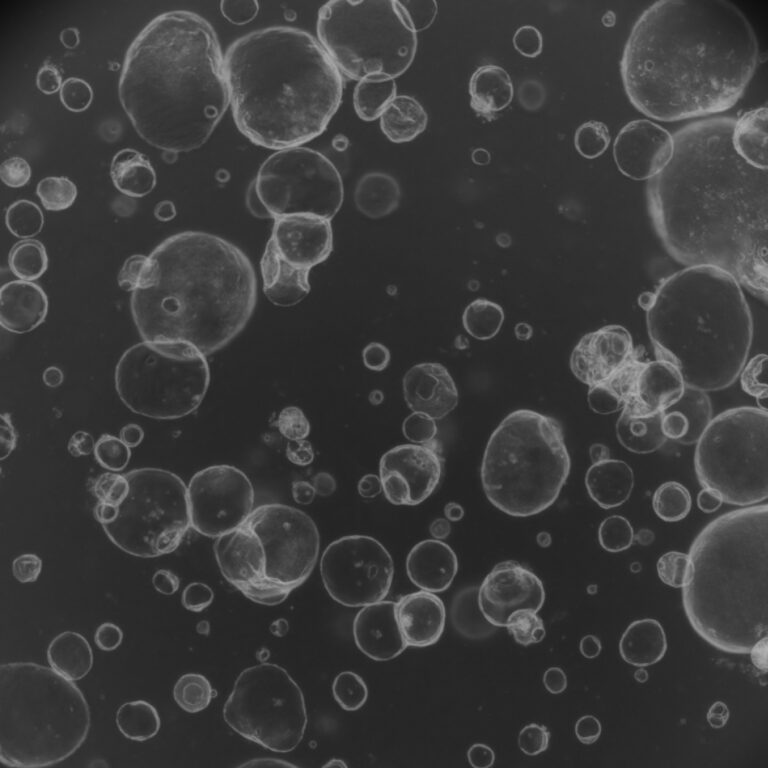
Organoid-based platforms make it possible to evaluate these questions in human-derived 3D tumor and normal tissue models before advancing ADC candidates. Human organoids are increasingly used as physiologically relevant models for studying disease mechanisms, drug efficacy, and toxicity because they can recapitulate key architectural and functional features of human tissues more closely than conventional 2D cell lines. Patient-derived tumor organoids can also preserve important characteristics of the original tumor, making them valuable for ADC research where tissue context, heterogeneous target expression, and payload sensitivity all matter (Wang et al., 2026).
Read more: What Are Organoids? | From Stem Cells to Mini-Organs
In This Article
Why ADC Development Needs Organoid-Based Efficacy and Toxicity Evaluation
ADC development requires more than confirming target expression. Even when targets such as HER2, TROP2, EGFR, c-Met, Nectin-4, or FRα are present, ADC efficacy still depends on antigen density, internalization, linker stability, payload release, payload sensitivity, and bystander activity. At the same time, toxicity can arise when the target is also expressed in normal tissues or when the payload affects non-tumor cells.
Traditional 2D cell lines are useful for early screening but often fail to reflect 3D tumor architecture, response heterogeneity, and tissue-specific toxicity. Animal models provide whole-body context but may not fully represent human target expression or payload sensitivity.
This is increasingly relevant as ADCs such as trastuzumab deruxtecan / Enhertu, sacituzumab govitecan / Trodelvy, datopotamab deruxtecan / Datroway, and telisotuzumab vedotin / Emrelis continue to expand across biomarker-defined cancer indications.
Organoid-based platforms help bridge this gap. Patient-derived cancer organoids can support functional ADC efficacy testing in human-relevant tumor models, while normal organoids can help evaluate on-target/off-tumor toxicity and organ-specific safety signals. By comparing tumor killing and normal-tissue toxicity under matched conditions, Lambda Biologics’ ADC evaluation platform helps define a more translational therapeutic window for ADC candidate selection.
Read more: Organoids vs. 2D Cell Lines: Which Is Better for ADC Research?
Lambda Biologics’s organoid-based ADC evaluation workflow
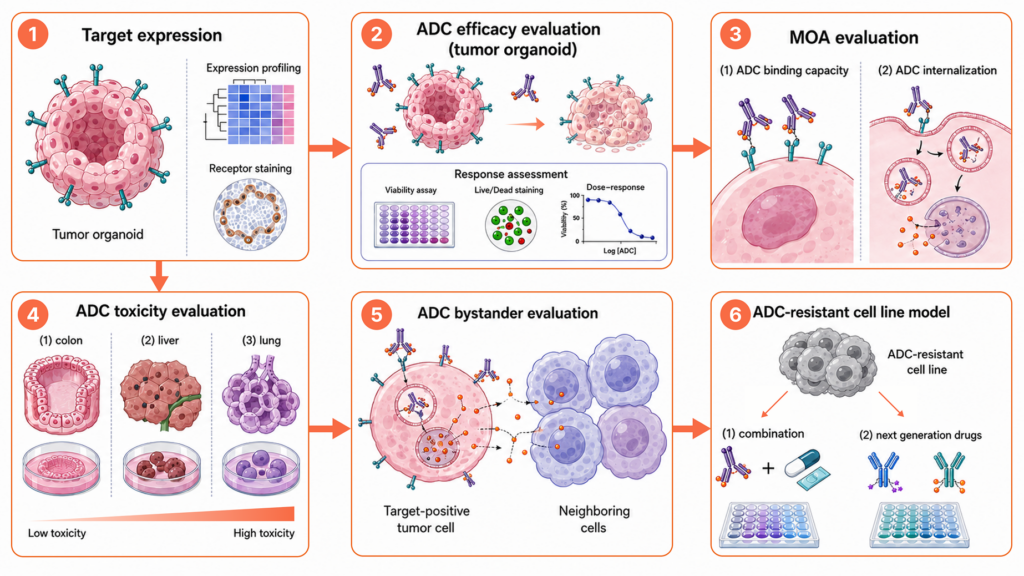
- Target expression profiling
Select cancer and normal organoids based on target expression level, tissue relevance, disease indication, and toxicity risk. - ADC efficacy evaluation
Measure dose-dependent tumor-organoid killing, potency, response heterogeneity, and payload-driven activity. Readouts may include IC50, EC50, Emax, organoid morphology, apoptosis, DNA damage, and payload-specific cytotoxicity markers. - Mechanism-of-action assessment
Evaluate ADC binding, internalization, intracellular payload activity, bystander effects, and target-dependent killing. This is important because ADC response depends not only on antigen expression but also on internalization, trafficking, linker cleavage, payload sensitivity, and bystander killing. - Normal organoid safety assessment
Test on-target/off-tumor toxicity and organ-specific toxicity signatures in relevant normal tissue models. Normal organoids can be selected based on known or suspected target expression, clinical toxicity concerns, and organ-specific risk hypotheses. - Therapeutic-window definition
Compare tumor efficacy and normal-organoid toxicity to rank ADC candidates by safety margin. The therapeutic window is the exposure range where tumor efficacy is maintained while normal tissue toxicity is minimized. - Comparative ADC evaluation
Benchmark antibodies, linkers, payloads, drug-to-antibody ratios, or competing ADC candidates across matched tumor and normal organoid models.
Response Prediction Using Large Organoid Datasets
As ADC datasets grow, organoid platforms can move beyond single-candidate testing toward response prediction. By linking molecular profiling, spatial profiling, and functional efficacy and toxicity readouts, large organoid datasets can help identify which tumor contexts are most likely to respond, which normal tissues may be at risk, and which ADC design produces the most favorable therapeutic window.
This is especially important because target expression alone may not fully predict ADC response. ADC sensitivity can be influenced by target density, membrane localization, internalization rate, lysosomal processing, linker cleavage, payload sensitivity, bystander effects, and the tumor microenvironment. With enough paired molecular and functional data, organoid platforms can help developers prioritize patient-enrichment strategies and compare ADC candidates before advancing them into more complex development stages.
The ODISEI Efficacy Testing Platforms Are Customizable for Your Study
Cultured directly from patient tumor biopsies, Lambda Biologics’ patient-derived organoids preserve key genetic, molecular, and phenotypic characteristics of the original tumor. These models provide a human-relevant platform for evaluating ADC efficacy, mechanism of action, tumor heterogeneity, and response variability across patient-derived cancer models.
Beyond cancer organoid-only assays, Lambda Biologics develops human-relevant tumor organoid platforms designed to incorporate critical aspects of the tumor microenvironment. These systems can integrate stromal and immune components, including cancer-associated fibroblasts, T cells, NK cells, and myeloid-derived suppressor cells, while allowing controlled modulation of extracellular and biochemical conditions relevant to specific cancer indications.
Leveraging this clinically relevant platform, Lambda Biologics delivers customized workflows tailored to ADC development needs.
Platform | Model format | Key application in ADC development |
#1 Cancer organoid only | Patient-derived cancer organoids cultured as 3D tumor models | Evaluates direct ADC-mediated tumor killing, dose-response activity, potency, organoid morphology, and payload-driven cytotoxicity. |
#2 Cancer organoid + T-cell co-culture | Cancer organoids co-cultured with T cells | Supports ADC efficacy testing in an immune-relevant setting and helps evaluate ADC plus immunotherapy strategies. |
#3 Cancer organoid + CAF co-culture | Cancer organoids co-cultured with cancer-associated fibroblasts | Assesses how stromal components influence ADC penetration, tumor resistance, and stromal protection. |
#4 Cancer organoid + NK-cell co-culture | Cancer organoids co-cultured with NK cells | Evaluates ADC activity in models where NK-cell proximity, immune engagement, and antibody-mediated immune effects may influence response. |
#5 MDSC infiltration assay | Cancer organoids tested with myeloid-derived suppressor cells | Models how immunosuppressive myeloid populations may affect ADC response, resistance, or combination strategy development. |
#6 Spatial biology immune profiling | High-plex spatial profiling of tissue or organoid samples | Maps ADC target expression, tumor heterogeneity, immune-cell organization, stromal context, and cell-cell interactions. |
Contact us to discuss your antibody-drug conjugate (ADC) development project
Spatial Biology Adds Tissue Context to ADC Development
ADC development is moving from an era of focusing only on target expression to an era of understanding spatial target biology. For ADCs, it is no longer enough to know whether the target is expressed. Developers also need to understand where the target is expressed, whether it is localized on tumor-cell membranes, how heterogeneous the expression is across tumor regions, and whether normal tissues may show on-target/off-tumor risk.
Spatial biology provides this missing tissue context by mapping target expression, tumor heterogeneity, immune organization, stromal interactions, and normal-tissue risk within the same sample. This is particularly relevant for ADC programs involving targets such as HER2, TROP2, and EGFR, where target distribution and tissue context can influence both efficacy and safety.
As an Akoya-certified partner providing PhenoCycler spatial biology services, we can help ADC developers add spatial target profiling to their ADC evaluation workflow. When combined with organoid-based testing, spatial biology supports better model selection, while cancer and normal organoids provide the functional layer for evaluating tumor killing, toxicity, and therapeutic window.
Read more: Explore Lambda Biologics’s Spatial Biology Services
References:
- Wang, R., Hu, B., Pan, Z. et al. Antibody–Drug Conjugates (ADCs): current and future biopharmaceuticals. Journal of Hematology & Oncology 18, 51 (2025). https://doi.org/10.1186/s13045-025-01704-3
- Wang, D., Villenave, R., Stokar-Regenscheit, N. et al. Human organoids as 3D in vitro platforms for drug discovery: opportunities and challenges. Nature Reviews Drug Discovery 25, 204–226 (2026). https://doi.org/10.1038/s41573-025-01317-y
Lambda Biologics’ Antibody-Drug Conjugates Evaluation Platforms
Contact us to discuss your
antibody-drug conjugate (ADC) development project