Viral hepatitis is an inflammation of the liver caused by one of five hepatitis viruses (A, B, C, D and E) that can lead to severe liver disease, cirrhosis and liver cancer. Chronic infection with hepatitis B or hepatitis C is the most serious form, because it can persist silently for decades before causing irreversible damage. According to the World Health Organization (WHO), 287 million people were living with chronic hepatitis B or C in 2024, and 1.3 million people died of these infections in the same year.
Observed every year on 28 July, World Hepatitis Day 2026 carries the theme “Hepatitis: Let’s break it down” – a call to remove the financial, social and systemic barriers, including stigma, that stand between people and the services that could save their lives.
This article explores what causes viral hepatitis, its key symptoms, how it is prevented and diagnosed, why it progresses to liver cancer, and how advanced organoid models are helping researchers study hepatocellular carcinoma with greater human relevance.
What Causes Viral Hepatitis?
Viral hepatitis is caused by infection with a hepatitis virus, and the route of transmission differs by type. Hepatitis B is transmitted through exposure to infected blood and body fluids – including needlestick injury, tattooing, piercing, the sharing or reuse of contaminated needles and syringes, and sexual contact – as well as from mother to child during birth.
The age at which infection occurs matters enormously. WHO reports that hepatitis B acquired in adulthood becomes chronic in fewer than 5% of cases, whereas infection in infancy and early childhood becomes chronic in roughly 95% of cases. This single fact is the scientific basis for prioritising infant and childhood vaccination – and it explains why WHO treats the timely birth dose as a critical intervention. Yet in 2024, only 45% of babies received the hepatitis B vaccine within 24 hours of birth.
What Are the Symptoms of Viral Hepatitis?
One of the most dangerous features of viral hepatitis is how quiet it is. WHO notes that many people with hepatitis A, B, C, D or E experience only mild symptoms or none at all. When symptoms do appear, they may include fever, malaise, loss of appetite, nausea and diarrhoea, and in acute illness, jaundice.
Because these signs are nonspecific and often absent entirely, chronic hepatitis B and C are frequently discovered only after significant liver damage has developed. This is precisely why WHO’s public call to action begins with a simple instruction: get tested for hepatitis B and C, rather than waiting for symptoms to prompt a visit.
World Hepatitis Day 2026: What “Let’s Break It Down” Means
The 2026 theme confronts an uncomfortable reality: the tools to eliminate viral hepatitis already exist. Effective vaccines, accurate diagnostics, curative treatments for hepatitis C and lifelong therapies for hepatitis B can prevent infections, save lives and reduce liver cancer and cirrhosis. Despite this, WHO reports that millions of people remain undiagnosed, untreated or unable to access care because of stigma, limited awareness, health system gaps and persistent inequalities.
WHO frames the 2026 campaign around five key messages: leverage existing science and policies; put people and communities at the centre of elimination; ensure equitable access to hepatitis services; integrate hepatitis care into universal health coverage; and accelerate research and innovation. That fifth message is where laboratory science meets public health strategy.
How Does Hepatitis Lead to Liver Cancer?
The pathway from infection to cancer is gradual and well characterised. Chronic hepatitis B or C infection drives persistent inflammation of liver tissue. Over years or decades, this inflammation produces fibrosis and then cirrhosis – extensive scarring that disrupts liver architecture. Against this background of chronic injury and continuous cell turnover, genetic damage accumulates, and hepatocellular carcinoma (HCC), the most common form of primary liver cancer, can develop.
The scale of the projected burden is significant. WHO estimates that without urgent and sustained action, viral hepatitis will cause an additional 2.1 million liver cancer cases by 2030, alongside 9.5 million new infections and 2.8 million deaths. Preventing infection interrupts this pathway at the start – but for patients who already have liver cancer, research needs models that reflect the real biology of human tumours.
Prevention, Testing and Treatment
WHO’s calls to action for the public are practical and achievable:
- Get tested for hepatitis B and C.
- Vaccinate newborns with a hepatitis B birth dose within 24 hours and complete the childhood vaccination series.
- Promote routine hepatitis B testing in antenatal care, with antiviral prophylaxis where needed, as part of the triple elimination of HIV, hepatitis and syphilis.
- Talk to a healthcare provider about early testing and treatment.
- Help stop stigma by sharing accurate information.
For governments and health authorities, WHO calls for decentralised testing and treatment integrated into primary care, hepatitis services embedded in universal health coverage, and sustainable funding backed by strong data systems.
Why Liver Cancer Research Needs Better Human Models
Translating WHO’s fifth key message into practice means improving the models researchers use. Conventional 2D cell cultures cannot reproduce the three-dimensional architecture, cellular diversity or microenvironment of a real liver tumour, and animal models often fail to fully replicate human liver pathology. The result is a translation gap: promising compounds that succeed in simplified systems but disappoint in patients.
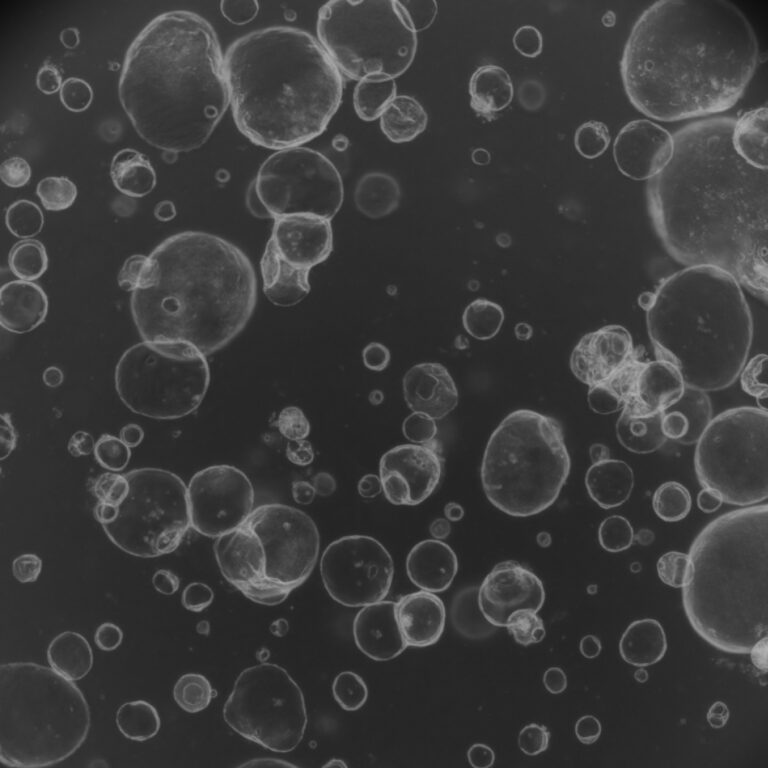
Organoids – self-organising, 3D tissue models grown from human cells – help close that gap. For liver cancer specifically, this means models built directly from hepatocellular carcinoma tissue.
Lambda Biologics Solution
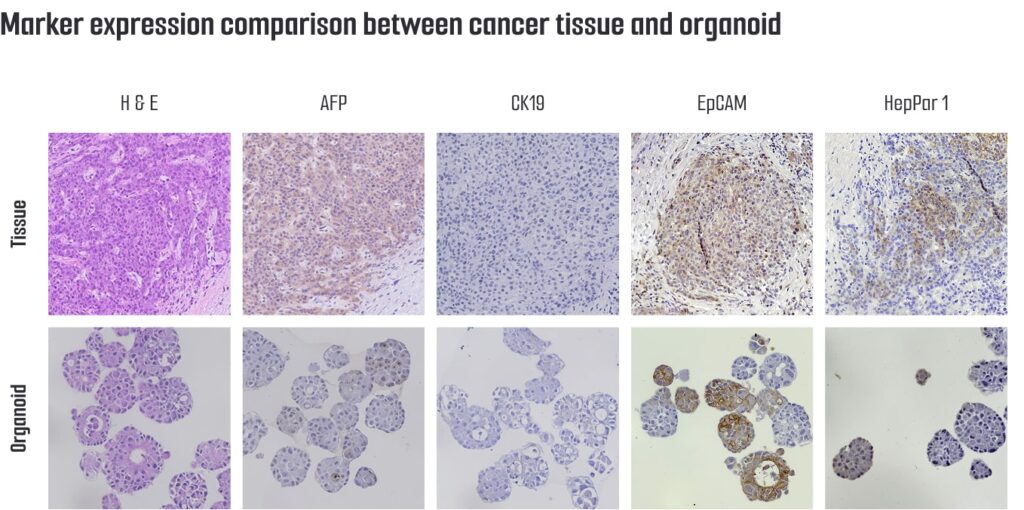
Lambda Biologics has developed Hepatocellular carcinoma organoids: 3D models that closely replicate the structure and cellular composition of actual cancer tissue. By preserving key characteristics of the original tumour – including genetic mutations and protein expression patterns – and by maintaining tumour heterogeneity and mimicking the tumour microenvironment (TME), they support the study of both disease progression and treatment response.
Lambda’s HCC organoids express key hepatocellular carcinoma markers including AFP, CK19, EpCAM and HepPar1. Immunohistochemistry analyses confirm these markers appear in patterns consistent with primary tumours, accurately reflecting the differentiation status and histological characteristics of the original tissue.
The platform supports toxicity and efficacy testing across small molecules, mRNA, antibodies and cancer vaccines – including responses to targeted therapies such as Sorafenib and Lenvatinib – as well as immuno-oncology studies incorporating cytotoxic T cells, tumour-infiltrating lymphocytes, regulatory T cells, macrophages and cancer-associated fibroblasts.
Because these models are human-derived, they also reduce reliance on animal testing, supporting a more ethical route to physiologically relevant data.
Read more: Hepatocellular Carcinoma Organoid – Lambda Biologics
Conclusion
World Hepatitis Day 2026 asks the global community to break down the barriers keeping proven interventions from the people who need them. Vaccination, testing and treatment prevent infections from ever becoming liver cancer, while stigma reduction and equitable access determine whether those tools actually reach people. At the same time, WHO’s call to accelerate research and innovation recognises that better science is part of the same effort.
Human-relevant models such as hepatocellular carcinoma organoids contribute to that final piece — helping researchers understand liver tumour biology, test therapies against genuinely representative tissue, and move precision oncology forward. Awareness protects people today; research protects them tomorrow.
Interested in bringing hepatocellular carcinoma organoids into your research? Contact Lambda Biologics to discuss your project with our team.
Lambda Biologics’s Organoid-based Discovery platform for Innovative Screening, Evaluation, and Identification