Status as of August 4, 2026: The House passed H.R. 2821 on July 20, 2026, while the Senate passed the companion bill, S. 355, in December 2025. Because the two chambers passed separate bills, final congressional action is still required before the legislation can go to the President. (GovInfo)
It is tempting to read FDA Modernization Act 3.0 as another major step toward ending animal testing in drug development. The direction is broadly correct, but that interpretation overstates what the legislation itself would do.
If enacted, the bill would require FDA regulations to refer to “nonclinical” rather than specifically “animal” tests, studies, data, models and research. It would make the regulatory language more inclusive of New Approach Methodologies (NAMs), but it would not ban animal studies or approve any organoid, organ chip or computational model for regulatory use. (GovInfo)
In This Article
How FDA Modernization Act 3.0 Builds on 2.0
The more significant legal change came with FDA Modernization Act 2.0, enacted in 2022. It updated federal law to clarify that drug developers may use a broader range of nonclinical testing methods – not only animal studies – to support certain regulatory submissions. These methods may include cell-based assays, organoids, organ-on-chip and microphysiological systems, computational models, and other human biology-based approaches.
However, while Act 2.0 changed the law, parts of FDA’s existing regulations continued to use animal-specific terminology. This created an inconsistency between the updated statute and the regulatory language sponsors use when preparing development programs and submissions.
FDA Modernization Act 3.0 is intended to close that gap. It does not introduce a new category of NAMs or create new regulatory permissions. Instead, it would require FDA to replace references to “animal” testing with the broader term “nonclinical” testing in relevant regulations.
In simple terms, Act 2.0 established the legal foundation for using alternative nonclinical methods, while Act 3.0 would update FDA’s regulations to reflect that foundation. Neither act bans animal testing or automatically qualifies a specific NAM for regulatory use. The acceptability of any method still depends on its scientific relevance, reliability, and defined context of use.
The Hard Part Is Still the Evidence
A NAM becomes useful when it can answer a defined scientific or regulatory question with sufficient reliability.
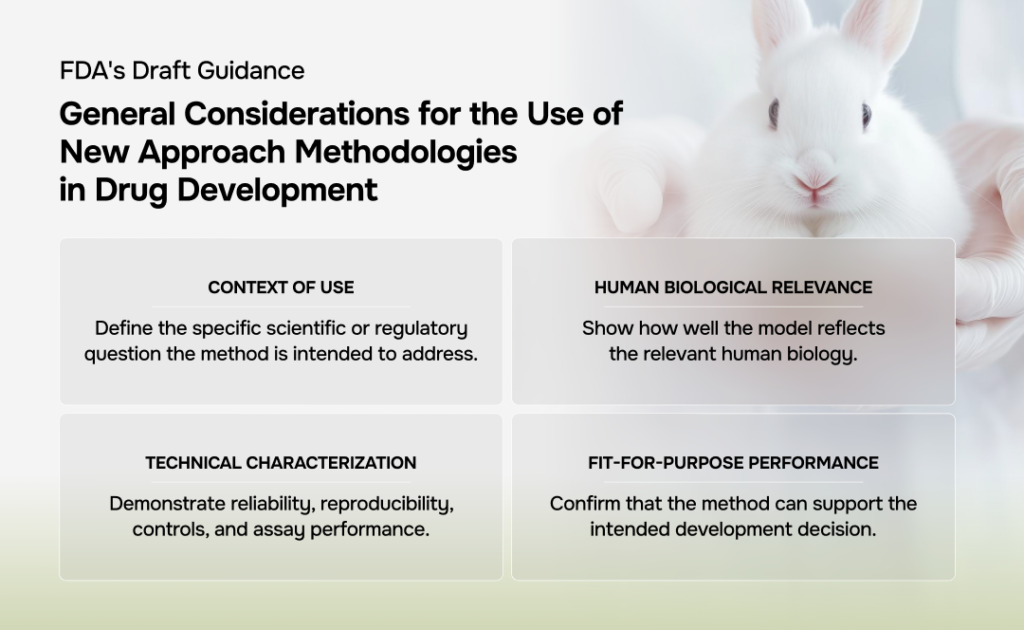
FDA’s March 2026 draft guidance identifies four central considerations:
- Context of use
- Human biological relevance
- Technical characterization
- Fit-for-purpose performance
FDA also notes that a NAM does not necessarily need to complete formal validation before it can be considered. A fit-for-purpose method may contribute to a weight-of-evidence assessment when its relevance, performance, and limitations are appropriately supported. (U.S. Food and Drug Administration)
The strongest regulatory argument is therefore not simply that a platform is a NAM. It is that the selected model and endpoints are suitable for a specific decision-for example, evaluating target-dependent tumor killing, investigating tissue-specific toxicity, or comparing tumor efficacy with normal-tissue response.
Why the Oncology Guidance Matters
FDA’s May 2026 draft guidance on streamlined nonclinical safety studies is more specific about reducing animal use in certain oncology programs.
The draft states that a weight-of-evidence assessment may replace animal toxicology studies when no pharmacologically relevant species exists. In some circumstances, general toxicology may use one rodent species rather than both rodent and non-rodent species.
The guidance also proposes streamlined approaches for certain PD-(L)1 antibodies, CD3 bispecific T-cell engagers and ADCs with well-characterized cytotoxic payloads. For certain ADCs, for example, the three-month toxicology study may be conducted in rodents only, with additional evidence where the antibody target is not represented in the species.
These recommendations remain draft and nonbinding. However, they show the practical discussion shifting from automatically repeating traditional study packages toward identifying the relevant biological risk and selecting evidence that addresses it. (U.S. Food and Drug Administration)
Read more: Organoid-Based Antibody-Drug Conjugate Evaluation Platform
Where Organoid-Based Testing Fits
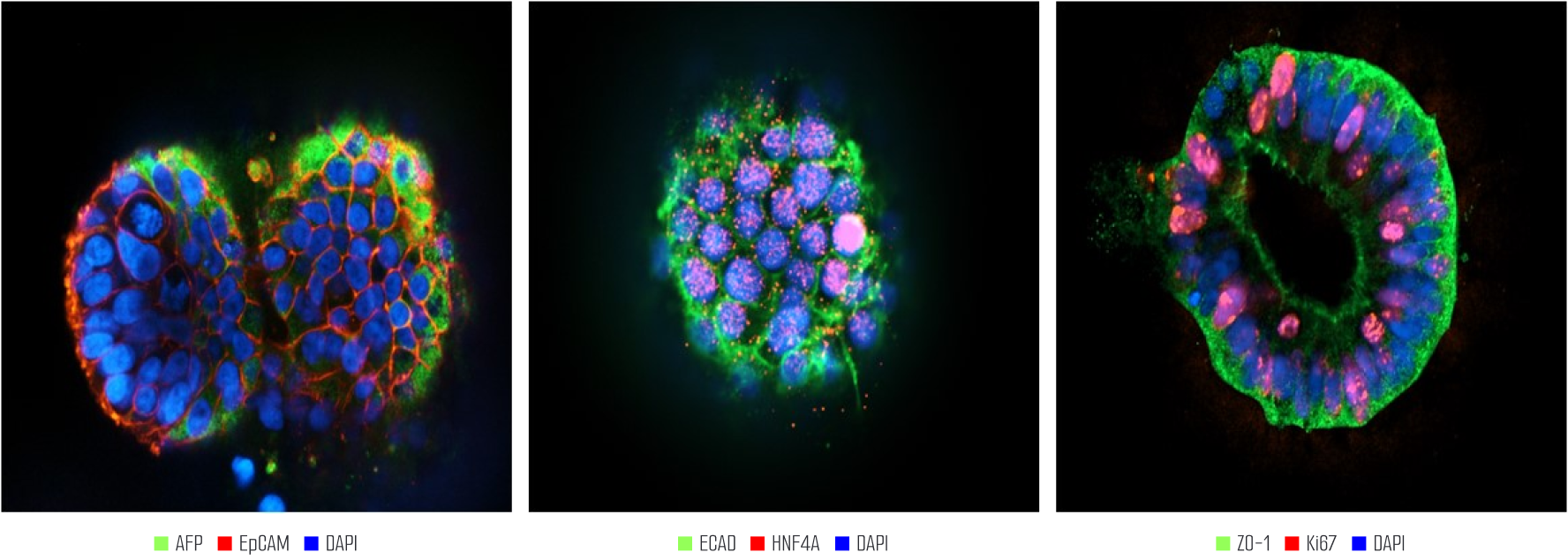
Lambda Biologics’ ODISEI platform supports this evidence-generation approach through patient-derived tumor organoids, immune and stromal co-culture systems, and normal adult tissue- or iPSC-derived organoids.
Patient-derived organoids can support response testing across heterogeneous tumor models. Co-culture with immune and stromal components adds biological context for evaluating checkpoint inhibitors, ADCs, monoclonal antibodies and cell therapies.
Normal organoids representing tissues such as the liver, heart, kidney, lung, intestine, skin, brain and retina can help investigate tissue-specific toxicity and candidate selectivity. Tumor and normal organoids may also be evaluated under comparable conditions to explore the potential therapeutic window.
Organoid data should not be presented as automatically replacing animal studies or as universally accepted by FDA. Their value depends on model characterization, reproducibility, appropriate controls, clinically meaningful exposure, relevant endpoints and a clearly defined context of use.
What Drug Developers Should Do Now
Start by reviewing each planned animal study and the decision it is intended to support. Then define the context of use before selecting a model.
Scientific confidence should be built through appropriate controls, benchmark compounds, reproducibility data, exposure confirmation, predefined acceptance criteria and transparent reporting of model limitations.
Early discussion with the relevant FDA review division also remains important when a NAM is intended to support a regulatory program. (U.S. Food and Drug Administration)
FDA Modernization Act 3.0 would remove an outdated wording barrier. But the future of NAM adoption will be determined less by the terminology of the bill than by the quality, relevance, and interpretability of the evidence.
Planning a Human-Relevant Efficacy or Toxicity Study?
Talk to Lambda Biologics about an organoid-based study designed around your molecule, biological question and development objectives.
Contact us to discuss your research!
Lambda Biologics’s Organoid-based Discovery platform for Innovative Screening, Evaluation, and Identification