For decades, neuroscience has operated on a foundational assumption: specific neurons perform specific jobs. Certain cells were believed to respond consistently to the same stimuli, forming stable neural representations that underpin memory, perception, and behaviour. But emerging evidence is now challenging that long-standing view.
A growing body of research now points to a phenomenon known as “representational drift,” in which neurons gradually change how they respond over time — even when behaviour and environmental conditions remain unchanged. The concept gained significant attention after neuroscientist Laura Driscoll, then at Harvard University and now at the Allen Institute in Seattle, observed unexpected changes in neuronal activity while tracking mouse brain cells over time.
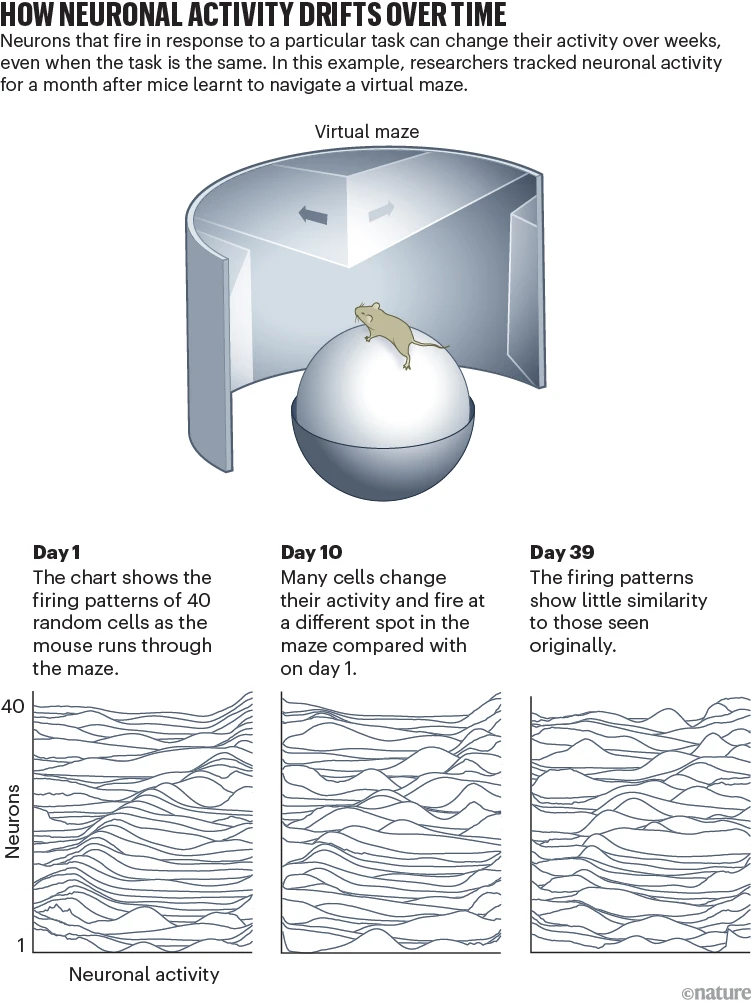
In a landmark 2017 study, Driscoll and colleagues found that neurons in the mouse parietal cortex reorganized their activity patterns over the course of weeks, despite the animals performing the same navigation task in a virtual maze. Individual neurons that once responded strongly to specific stimuli stopped doing so, while others became newly responsive. Yet, importantly, broader patterns across neuronal populations remained relatively stable. The findings suggested that the brain may rely less on fixed roles for individual neurons and more on coordinated activity across neural populations.
Since then, evidence for representational drift has emerged across multiple brain regions, including the hippocampus, visual cortex, and olfactory cortex. Researchers such as Andrew Fink at Northwestern University, Clifford Kentros at the Kavli Institute for Systems Neuroscience in Norway, and Yaniv Ziv at the Weizmann Institute of Science in Israel have all contributed to expanding the field’s understanding of these shifting neural representations.
The phenomenon remains controversial. Michael Yartsev at the University of California, Berkeley, has reported stable hippocampal activity in bats, while Juan Gallego at the Champalimaud Centre for the Unknown in Portugal argues that some apparent drift may instead reflect subtle behavioural variations.
Despite ongoing debate, representational drift is reshaping how scientists think about memory and brain function. Researchers including Denise Cai at the Icahn School of Medicine at Mount Sinai suggest that drift may help encode time, integrate new experiences into memory, and maintain cognitive flexibility.
Beyond neuroscience, these findings may influence the future design of brain–machine interfaces and artificial intelligence systems. As the field continues to evolve, representational drift is emerging not as a minor anomaly, but as a profound challenge to how the brain itself is understood.
>> Read the full article on Nature.com
Working on your next brain research? You might be interested in Lambda Biologics’ Neuroscience Solutions:
iPSC brain organoid & organoid drug evaluation platform
Midbrain Organoid | Cerebral Organoid