Human brain development unfolds over years, yet most brain organoid studies capture only its earliest stages. Researchers at Harvard University and collaborating institutes have now maintained cortical organoids for up to five years, showing that they continue to acquire transcriptional and epigenetic signatures of developmental age—and may even retain a molecular “memory” of time already passed.
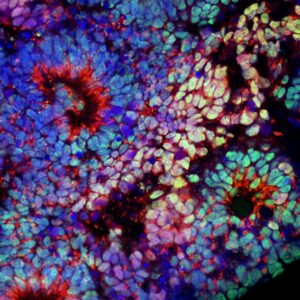
(Image for illustration purpose only: IF Staining Brain Organoid, by OrganoidSciences)
Extending Brain Development in Vitro
Human brain development unfolds over years, yet most brain organoid studies capture only relatively early developmental stages. This has limited their usefulness for investigating the prolonged postnatal maturation that is particularly characteristic of the human cortex.
Researchers led by Harvard University’s Department of Stem Cell and Regenerative Biology, working with the Broad Institute of MIT and Harvard, MIT and the Max Planck Institute for Molecular Genetics, have now followed human cortical organoids for as long as five years.
The central shift is not simply that the organoids survived longer. Their molecular states changed with time in ways that paralleled aspects of human brain development. Single-cell transcriptomics revealed progressively later developmental signatures, while whole-genome methylation profiling showed that predicted epigenetic age closely tracked time spent in culture. An activity-permissive medium also supported morphologically mature excitatory neurons and functional neuronal networks for at least two years
Perhaps the most distinctive finding came from mixing neural progenitors of different ages. Progenitors from older organoids retained a form of developmental memory: when exposed to younger cells, they responded to neurogenic signals but skipped earlier developmental stages they had already completed and rapidly generated later neuronal fates.
The work therefore extends brain organoids from models primarily associated with early development towards systems capable of experimentally probing human developmental timing over multi-year periods. Important limitations remain: long-term organoids do not reproduce the full vascular, sensory and systemic environment of the developing brain, and neuronal representation declined under conventional culture conditions. Still, the study shows that developmental time itself can be recorded and interrogated in vitro.
Reference: Faravelli, I., Antón-Bolaños, N., Wei, A. et al. “Human brain organoids record the passage of time over multiple years”. Nature (2026). DOI: 10.1038/s41586-026-10877-x.
Working on Brain research?
Explore our Brain Organoid Platform and Neurodegeneration Disease Models