A new Cell study from Johns Hopkins University introduces a way to reconstruct hair-follicle development in both space and time from a single tissue sample, revealing how normal and disrupted organogenesis unfold at molecular resolution.
Mapping Development in Four Dimensions
Understanding how an organ forms usually means choosing between molecular detail, spatial context and developmental time. The researchers developed 3DEEP, a deep-tissue spatial transcriptomics method capable of profiling RNA hundreds of micrometres into intact tissue.
Applied to newborn mouse skin, the approach captured hundreds of developing hair follicles at different stages. By ordering follicles according to their molecular age, the team transformed a single spatial snapshot into a four-dimensional map of hair-follicle organogenesis.
The map revealed early organisation of stem-cell compartments, coordinated formation of the follicle bulb and hair canal, and an important disease insight: Foxn1-deficient “nude” follicles showed delayed and less coordinated molecular development before obvious structural defects appeared.
The broader shift is methodological. Developmental abnormalities may become visible as disruptions in timing and coordination, not only as anatomical defects.
Although the study is mouse-based, it suggests a richer way to evaluate regenerative models: not simply what cells are present, but whether they are developing in the right place, in the right order and at the right time.
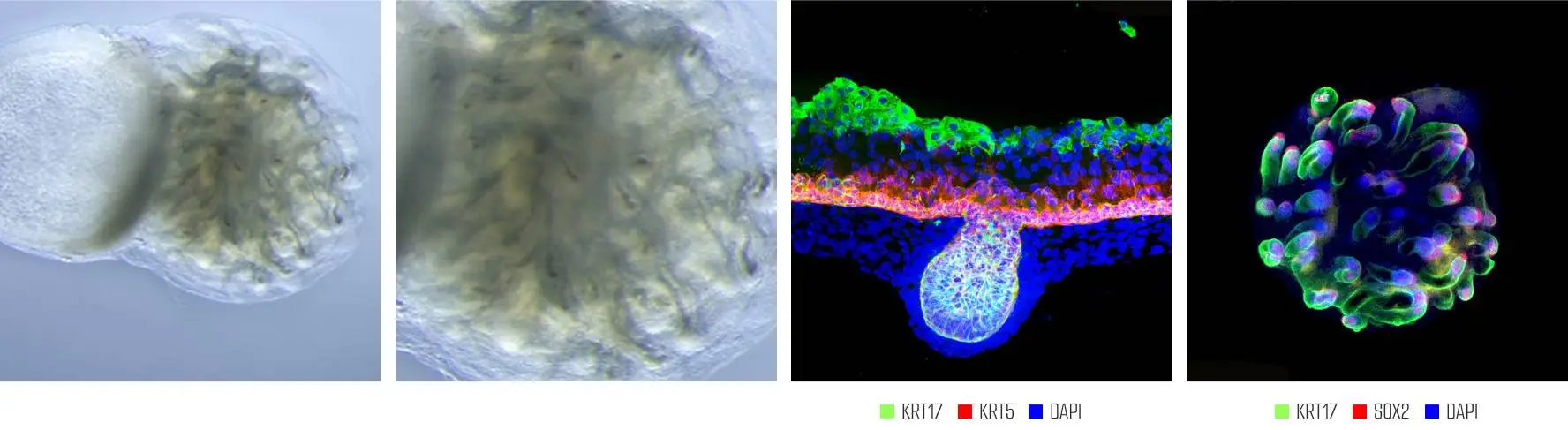
3D Skin and Hair Organoid Model
Lambda Biologics’ skin and hair organoid model recreate key aspects of tissue architecture in vitro, enabling more physiologically relevant studies of hair growth, skin regeneration, anti-aging, wound healing, and cosmetic efficacy. By providing a 3D tissue environment rather than conventional 2D cultures, these models help researchers investigate complex biological responses and mechanisms of action with greater relevance to human tissue.
Reference
Asami, S., Yin, C., Fan, J., Garza, L. A. & Kalhor, R. “Four-dimensional molecular mapping from a spatial snapshot reveals the dynamics of hair follicle organogenesis.” Cell 189 (2026). DOI: 10.1016/j.cell.2026.06.014.
Interested in Patient-derived Organoid powered research? Check out Lambda Biologics’ Skin & Hair Organoid Platform:
Skin & Hair Organoid | Artificial Skin | Melanocytes | Retinal Organoid | See more…