A Skin-hair Organoid-based Model

Efficacy Evaluation Model for Androgenic Alopecia using Hair Organoids

A hair-bearing organoid model derived from embryonic stem (ES) cells for evaluating therapies against androgenic alopecia (AGA). This platform overcomes limitations of conventional in vitro models, providing a robust system for testing therapeutic and cosmetic interventions for hair loss.

Challenges

Hair loss, especially androgenic alopecia, remains a significant unmet medical and cosmetic need. This study highlights several critical challenges in the field:

Limited treatment options

Only two FDA-approved drugs (topical Minoxidil and oral Finasteride) exist for hair loss, both with limitations including side effects and gender restrictions.

Lack of suitable disease models

No reliable in vitro model exists to induce androgenic alopecia, making it difficult to evaluate new therapies and understand molecular mechanisms.

Gap between cellular and clinical research

Conventional 2D cell cultures and short-term ex vivo models fail to replicate the complex, long-term pathophysiology of androgenic alopecia.

Ethical and practical barriers

Clinical studies face ethical challenges, while animal models have translational limitations for human hair biology.

Hair Organoids for Androgenic Alopecia Research:

Beyond Conventional Models

Hair Organoids for Androgenic Alopecia Research: Beyond Conventional Models

The researchers developed a human embryonic stem cell (hESC)-derived 3D hair-bearing skin organoid model that can successfully recapitulate androgenic alopecia-like conditions through long-term DHT (dihydrotestosterone) treatment. This organoid system bridges the gap by:
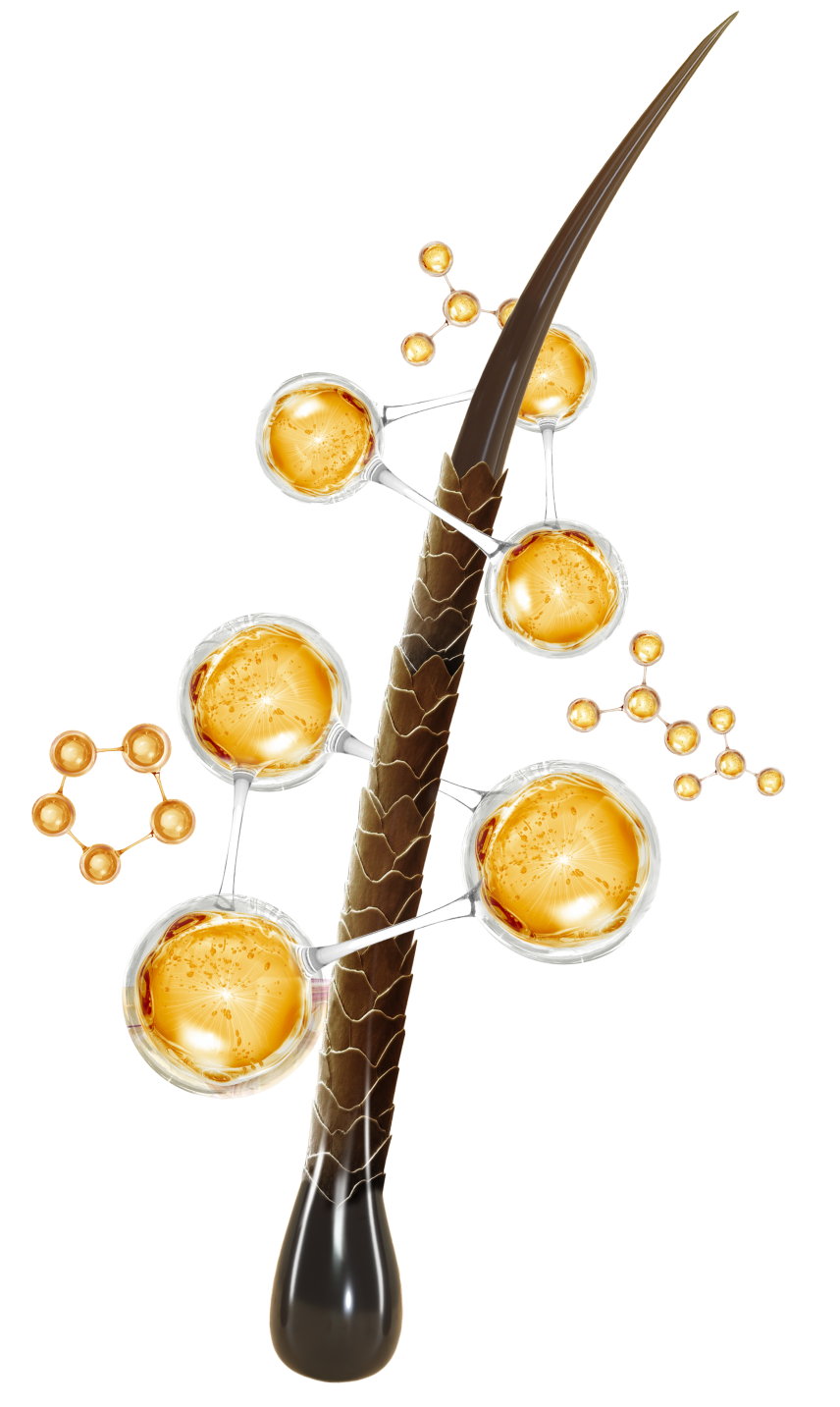
Stylized plant stem with orange molecular spheres connected by white bonds, on a black background.
Dark chocolate wand surrounded by orange molecular spheres on a black background.

Human-Relevant 3D Hair Follicle System

Developed a hair-bearing scalp organoid derived from human embryonic stem (ES) cells that mimics the structural and functional characteristics of human hair follicles and scalp tissue.

Multi-Level Efficacy Validation

The organoids enable long-term evaluation of anti-hair loss agents. Both FDA-approved Minoxidil and the Korean FDA-certified ingredient SOYACT demonstrated protective effects by preserving hair follicle number, maintaining pigmented hair shafts, and restoring key biomarkers (SOX2, PCNA, COL17, and KRT15).

AGA Disease Modeling with DHT

Successfully established an androgenic alopecia-like model by DHT treatment, reproducing follicular regression, reduced proliferation, and stem cell niche impairment observed in hair loss conditions.

Translational Platform for Hair Research

Provides a long-term, physiologically relevant platform that bridges conventional cell assays and clinical studies, supporting therapeutic screening, mechanism studies, and cosmetic efficacy evaluation.

Discuss Your Hair Research

Our scientists will help design a human-relevant disease modeling study.

Related Solutions

Organoid Service
Organoid Service
Research Service
Research Service

Workflow

Step 1 – Organoid Generation

Differentiate human embryonic stem cells into 3D skin/scalp organoids with hair follicles through stepwise culture and growth factor induction.

Step 2 – Hair Follicle Maturation

Culture organoids for >100 days until mature, pigmented hair shafts form.

Step 3 – Induction of Hair Loss

Treat organoids with DHT to induce androgenic alopecia-like follicular regression.

Step 4 – Compound Treatment

Administer Minoxidil or SOYACT to evaluate anti-hair loss efficacy.

Step 5 – Multi-Level Evaluation

Assess efficacy using:
  • Hair follicle counts and morphology
  • Hair shaft growth
  • Cell proliferation assays
  • Growth factor analysis (VEGF, HGF)
  • Immunofluorescence biomarkers (SOX2, PCNA, COL17, KRT15)

Result

Successful Generation of Hair-Bearing Skin Organoids

The researchers successfully cultured skin organoids from human embryonic stem cells (hESCs) that developed hair follicles. Hair germs appeared at DIV 60, followed by proliferation at DIV 80. By DIV 100–150, mature pigmented hair shafts were clearly visible, confirming the formation of functional hair-bearing skin organoids.
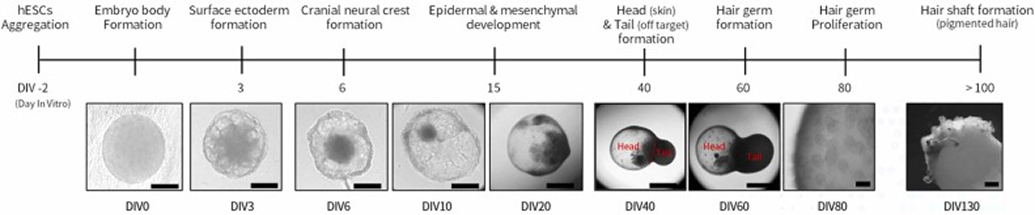
Kyung et al., 2026

In Vitro Effects on Dermal Papilla Cells (DPCs)

Both Minoxidil (MXD) and SOYACT significantly promoted DPC proliferation (120–140% increase). They also upregulated key hair growth factors: Increased mRNA and protein expression of VEGF and HGF. These beneficial effects were maintained even in the presence of DHT.

In human hair follicle organ culture, treatment with MXD and SOYACT (20–200 µg/mL) significantly enhanced hair shaft elongation compared to controls. The hair growth-promoting effect was evident by day 8, even under DHT-induced conditions.
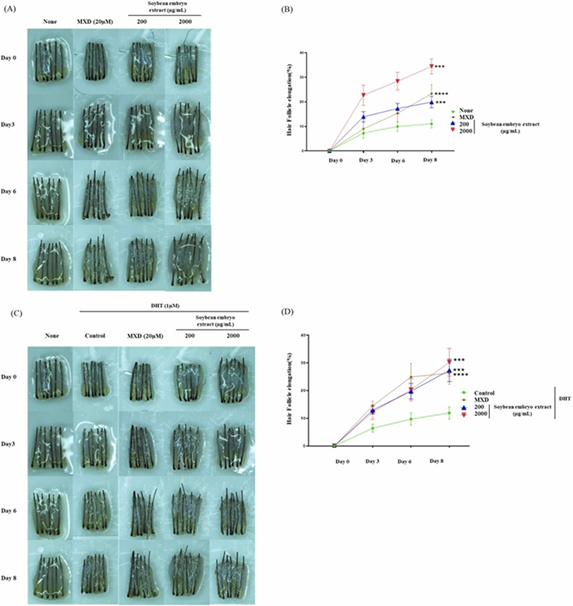
Kyung et al., 2026

Protection Against DHT-Induced Alopecia in Organoids

Long-term DHT treatment (1 µM for 50 days starting at DIV 100) induced androgenic alopecia-like changes in the organoids, including:

  • Pronounced follicular shrinkage
  • Significant reduction in the number of mature pigmented hair follicles

In contrast, co-treatment with MXD (50 µM) or SOYACT (200 µg/mL) effectively preserved follicular structure, maintained higher numbers of pigmented hairs, and showed clear protective effects.
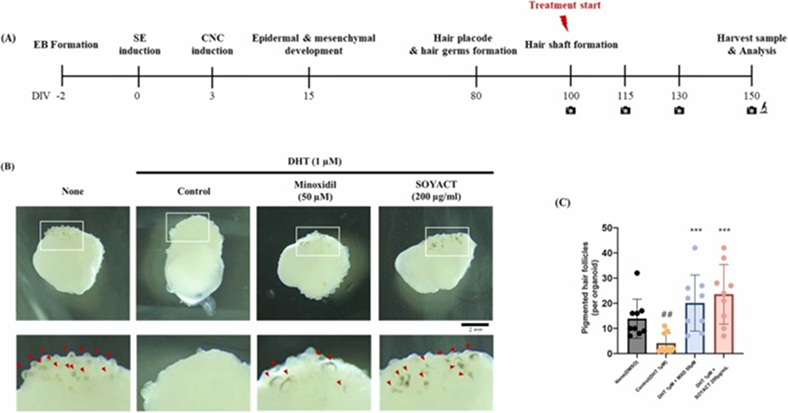
Panel A shows a developmental timeline from EB formation to harvest/analysis with labeled stages. Panel B displays four treatment groups (None, Control, Minoxidil 50 μM, SOYACT 200 μg/mL) with top and magnified bottom images of EBs highlighting areas of interest and red markers. Panel C presents a bar chart of the percentage of hair follicle-like structures across groups with error bars and significance marks.
Kyung et al., 2026

Restoration of Molecular Hair Development Markers

Immunofluorescence analysis revealed that DHT markedly decreased critical hair follicle markers:

  • SOX2 (dermal papilla stemness)
  • PCNA (cell proliferation)
  • COL17 and KRT15 (hair follicle stem cell niche integrity)

Treatment with MXD or SOYACT successfully restored the expression of these biomarkers, often bringing them back to or above control levels.

Overall Result: The study demonstrated that the hair organoid model can reliably recapitulate androgenic alopecia upon DHT exposure and effectively evaluate the anti-hair loss efficacy of both a known drug (Minoxidil) and a cosmetic ingredient (SOYACT) at macroscopic (hair count) and microscopic (biomarker) levels.
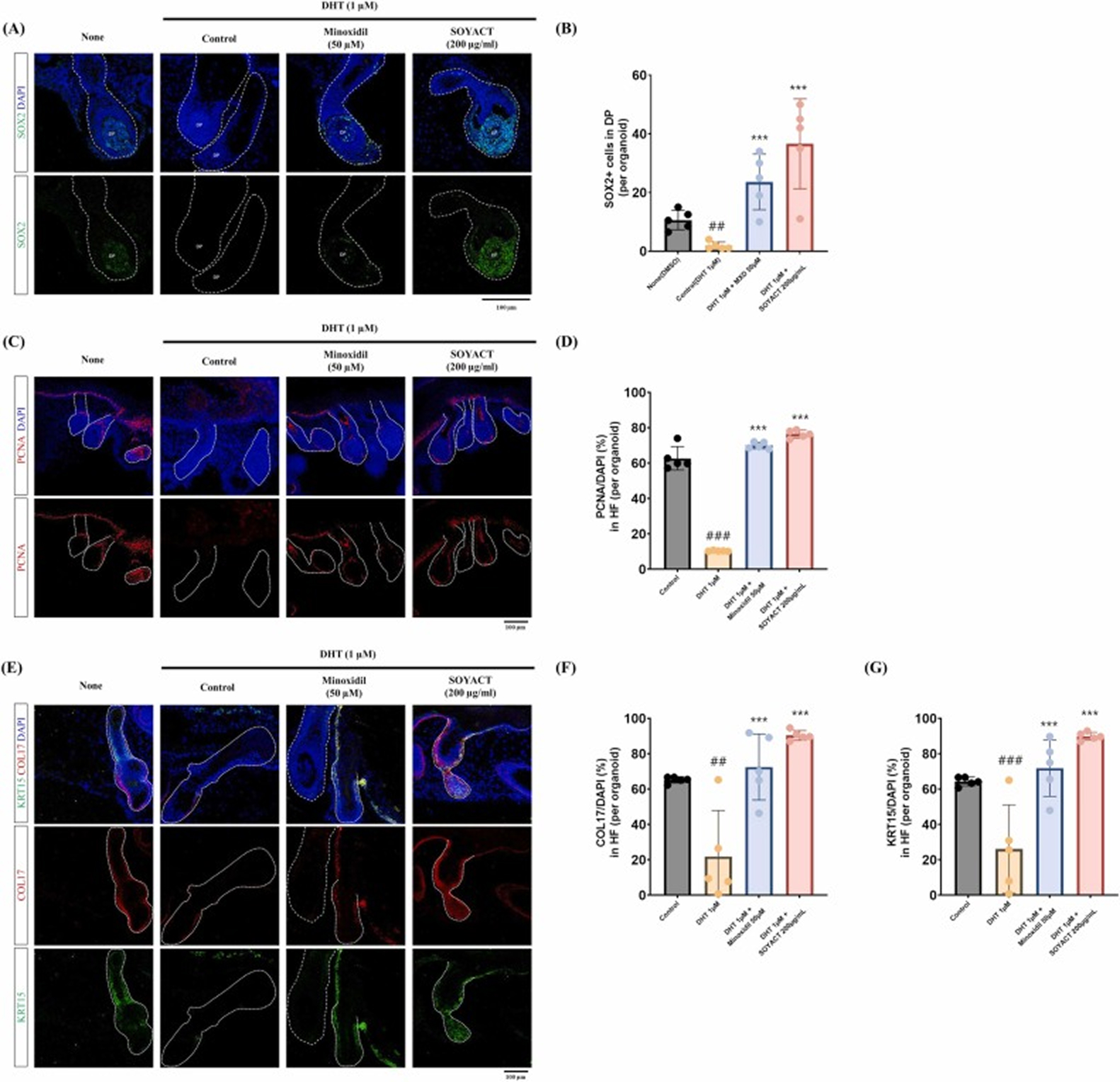
Series of panels showing immunofluorescent images of organoids with DAPI nuclear stain and marker signals under different treatments (None, Control, Minoxidil, SOYACT) and corresponding bar graphs quantifying marker-positive cells per organoid.

Discuss Your Hair Research

Our scientists will help design a human-relevant disease modeling study.

Impact

  • Pioneering Platform

    Demonstrates the first successful use of hair organoids for anti-hair loss efficacy evaluation, showing consistent results across in vitro, ex vivo, and organoid systems.
  • Animal Alternative

    Powerful human-relevant platform that reduces reliance on animal testing, aligning with NAMs and EU regulations.
  • Long-Term Insight

    Enables extended observation of hair growth and miniaturization not possible in short-term models.
  • Drug Acceleration

    Speeds up discovery and validation of new hair loss treatments.
  • Translational Bridge

    Connects basic research to clinical applications in hair science.

Your CRO Partner for Neuroscience Drug Discovery

Human-relevant disease modeling services by Lambda Biologics

Read Other Case Study

Thank you for your insterest

You can now download the file.

Connect with Us