An intestinal organoid is three-dimensional (3D) in vitro model derived from human intestinal stem cells or induced pluripotent stem cells (iPSCs). These cells self-organize into structures that closely resemble the human intestinal epithelium, reproducing key features such as crypt–villus architecture, multiple intestinal cell types, and essential physiological functions.
Unlike traditional 2D cell cultures, intestinal organoids capture the complexity of the human gut, including barrier formation, cellular differentiation, and functional responses to external stimuli.
Working on gut disease research? Discover Lambda Biologics’s intestinal organoid solutions
How Intestinal Organoids Are Generated
Intestinal organoids are typically established by isolating intestinal stem cells from patient biopsies or differentiating iPSCs toward an intestinal lineage. The cells are embedded in an extracellular matrix (ECM)-rich environment that supports 3D growth and long-term expansion.
Two main types are commonly used:
- Patient-derived intestinal organoids (PDOs), which preserve patient-specific genetic and disease characteristics.
- iPSC-derived intestinal organoids, which are useful for developmental and genetic studies.
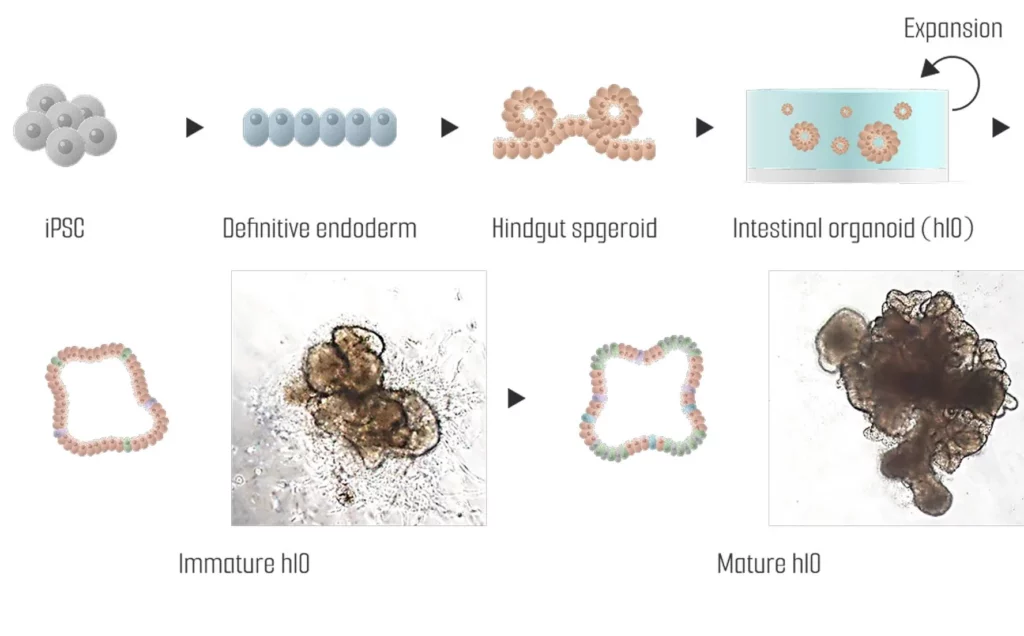
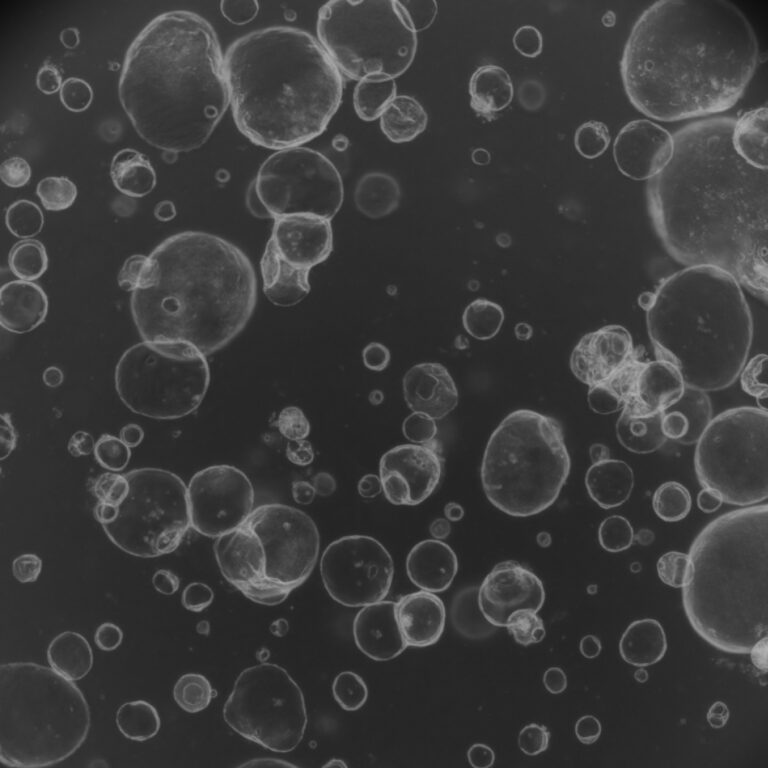
Image: iPSC-derived intestinal organoids
Why Intestinal Organoids Are a Better Choice Than Traditional Models
Intestinal organoids have rapidly become a preferred model because they overcome many limitations of conventional systems.
Compared with 2D intestinal cell lines, organoids offer:
- Multiple differentiated intestinal cell types
- Physiologically relevant barrier and transporter functions
- Improved prediction of human responses
Compared with animal models, intestinal organoids provide:
- Human-specific biology
- Reduced species-dependent bias
- Alignment with non-animal testing strategies
These advantages make intestinal organoids highly suitable for translational research and preclinical decision-making.
Read more: Human Intestinal Organoids: Promise and Challenge
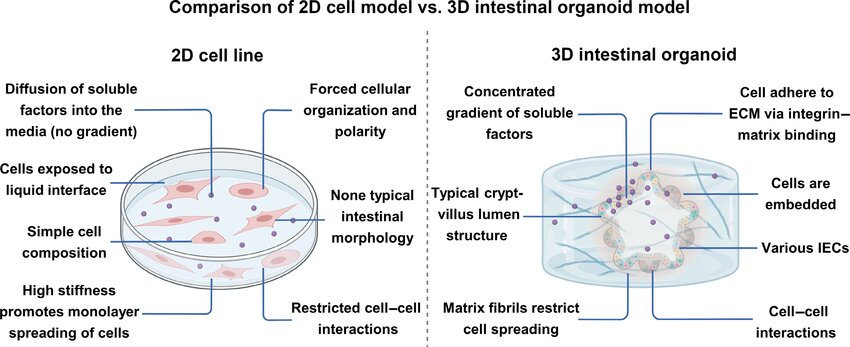
Image source: Bao, Lin & Xuejing, Cui & Bai, Ru & Chen, Chunying. (2023). Advancing intestinal organoid technology to decipher nano–intestine interactions and treat intestinal disease. Nano Research. 16. 3976-3990. 10.1007/s12274-022-5150-4.
Key Applications of Intestinal Organoids
Intestinal organoids are widely used to study gut function, disease mechanisms, and therapeutic responses in a human-relevant context.
Leaky Gut Syndrome (Intestinal Barrier Recovery)
Leaky gut syndrome is characterized by impaired intestinal barrier integrity, leading to increased permeability and inflammation. Intestinal organoids enable direct assessment of barrier disruption and recovery by analyzing tight junction proteins, permeability changes, and epithelial regeneration.
This model is particularly valuable for evaluating drugs, probiotics, and nutritional compounds designed to restore intestinal barrier function.
Read more: Stem cell-derived intestinal organoids: a novel modality for IBD
Inflammatory Bowel Disease (IBD)
Inflammatory Bowel Disease, including Crohn’s disease and ulcerative colitis, involves chronic inflammation, epithelial damage, and abnormal tissue repair. Patient-derived intestinal organoids allow researchers to model disease-specific phenotypes and investigate individual responses to anti-inflammatory and immunomodulatory therapies.
Organoid-based IBD models support precision medicine approaches by capturing patient-to-patient variability.
Intestinal Fibrosis
Intestinal fibrosis is a serious complication of chronic intestinal inflammation, particularly in Crohn’s disease. It involves excessive extracellular matrix deposition and tissue stiffening. Intestinal organoids cultured in ECM-rich environments can be used to study fibrotic signaling pathways and screen compounds that target fibrosis progression rather than inflammation alone.
Intestinal Adhesion Ability
Intestinal adhesion ability refers to the capacity of epithelial cells to attach, spread, and regenerate on extracellular matrices following injury. Organoid-based adhesion models help evaluate epithelial repair, cell–ECM interactions, and tissue regeneration processes, supporting the development of therapies aimed at enhancing mucosal healing.
Intestinal Toxicity Assessment
Many drugs and chemicals induce gastrointestinal side effects that are poorly predicted by animal models. Human intestinal organoids enable direct evaluation of intestinal toxicity by assessing cell viability, barrier integrity, and stress responses under acute or chronic exposure conditions.
These models support early safety assessment and non-animal toxicology strategies.
Regulatory Relevance And Non-animal Testing
Intestinal organoids align well with global efforts to reduce animal testing under the 3Rs principles (Replace, Reduce, Refine). They are increasingly recognized as advanced in vitro models compatible with OECD-aligned non-animal testing approaches, particularly for safety and toxicity evaluation.
Lambda Biologics Intestinal Organoids
Lambda Biologics provides human-relevant intestinal organoid platforms designed to address key challenges in gut disease research and drug development. Our intestinal organoids are derived from high-quality human samples and integrated with ECM-based systems to model barrier function, inflammation, fibrosis, adhesion, and toxicity.
With customizable study designs and disease-focused readouts, Lambda Biologics supports pharmaceutical, biotechnology, and life science partners in generating predictive, translational data using advanced intestinal organoid models.
Unlocking Human Insight with Organoid Models
Cerebral Organoid | Midbrain Organoid | Skin & Hair Organoid | Intestine Organoid | Kidney Organoid | Cardiac Organoid | Liver Organoid | Gastric Organoid | Lung Organoid