
Ovarian cancer remains one of the most lethal gynecologic malignancies worldwide. Often referred to as the “silent killer,” ovarian cancer is frequently diagnosed at advanced stages because early symptoms, including bloating, abdominal discomfort, and changes in urinary habits, are often subtle and nonspecific. The lack of effective screening methods further contributes to delayed diagnosis. In fact, of the 21,010 women who will receive an ovarian cancer diagnosis in 2026, nearly 12,450 of them will die from it, according to the American Cancer Society (ACS).
Despite advances in surgical techniques and systemic therapies, ovarian cancer continues to present significant clinical challenges due to high recurrence rates and the development of treatment resistance. These unmet needs have accelerated the search for more predictive preclinical models and precision oncology approaches capable of identifying effective therapies for individual patients.
In This Article

Current Challenges in Ovarian Cancer Treatment
The current standard of care for ovarian cancer typically consists of cytoreductive surgery followed by platinum-based chemotherapy. Although many patients initially respond to treatment, recurrence remains common, particularly among patients diagnosed with advanced-stage disease.
Platinum Resistance
One of the greatest challenges in ovarian cancer management is platinum-resistant ovarian cancer (PROC). Historically, platinum resistance has been defined as disease recurrence or progression occurring within six months of completing platinum-based chemotherapy, although recent research suggests that treatment response exists along a continuum rather than within rigid categories [4].
Tumor Heterogeneity and Therapeutic Resistance
Ovarian tumors display significant interpatient and intratumoral heterogeneity. Clonal evolution, genomic instability, and interactions within the tumor microenvironment contribute to variable responses to therapy and the emergence of treatment resistance [2,3].
Limited Predictive Biomarkers
Although biomarkers such as BRCA1/2 mutations, homologous recombination deficiency (HRD), and folate receptor alpha (FRα) expression have enabled more personalized treatment strategies, many ovarian cancer patients still lack actionable biomarkers that can effectively guide therapeutic decision-making [5].
Translational Gaps in Drug Development
Despite encouraging preclinical findings, many investigational therapies fail to demonstrate clinical benefit. One contributing factor is the limited ability of traditional two-dimensional cell cultures and animal models to fully replicate the biological complexity and heterogeneity of human ovarian tumors [6].
Read more:
An organoid platform for ovarian cancer captures intra- and interpatient heterogeneity
New Advances in Ovarian Cancer Treatment
Recent clinical developments have generated considerable optimism, particularly for patients with platinum-resistant ovarian cancer.
ROSELLA Trial: A New Strategy for Platinum-Resistant Disease
One of the most important ovarian cancer updates of 2025 was the Phase III ROSELLA trial, which evaluated relacorilant, a selective glucocorticoid receptor antagonist, in combination with nab-paclitaxel in patients with platinum-resistant ovarian cancer.
According to experts interviewed by Oncology News Central, ROSELLA was considered one of the most impactful ovarian cancer studies presented in 2025 because it demonstrated clinically meaningful improvements in both progression-free survival and overall survival compared with chemotherapy alone. The study introduced a novel therapeutic approach targeting glucocorticoid receptor signaling, a pathway implicated in tumor survival and chemotherapy resistance.²
The success of relacorilant highlights the potential value of exploring non-traditional resistance pathways in ovarian cancer and may provide a new treatment option for patients with limited therapeutic choices.
KEYNOTE-B96: Expanding Immunotherapy in Ovarian Cancer
Another major breakthrough discussed in the 2025 ovarian cancer landscape was the Phase III KEYNOTE-B96 trial, which evaluated pembrolizumab in combination with weekly paclitaxel, with or without bevacizumab, in recurrent platinum-resistant ovarian cancer.
Historically, immunotherapy has demonstrated limited efficacy in ovarian cancer compared with other solid tumors. However, the positive results from KEYNOTE-B96 suggest that selected patients may benefit from immune checkpoint blockade when used in rational combination regimens.
The study represents an important step toward expanding immunotherapy strategies in ovarian cancer and may help establish new treatment paradigms for recurrent disease.
Elahere Expands Targeted Treatment Options
In 2024, the U.S. Food and Drug Administration (FDA) granted full approval to Elahere® (mirvetuximab soravtansine-gynx) for patients with folate receptor alpha (FRα)-positive, platinum-resistant ovarian cancer.
Elahere is an antibody-drug conjugate (ADC) that selectively targets FRα, a protein highly expressed in many ovarian tumors. The approval was supported by results from the Phase III MIRASOL trial, which demonstrated improvements in overall survival, progression-free survival, and objective response rates compared with investigator’s choice chemotherapy.
Importantly, Elahere became the first therapy shown to improve overall survival in patients with FRα-positive platinum-resistant ovarian cancer, highlighting the growing role of biomarker-driven treatment strategies in gynecologic oncology.
Read more:
What Are Antibody-Drug Conjugates (ADCs)? Organoid Platforms for ADC Research
Approval of Elahere Expands Treatment Options for Some Advanced Ovarian Cancers
Ovarian Cancer Organoids: A Next-Generation Research Platform
The emergence of therapies such as relacorilant, pembrolizumab-based combinations, and FRα-targeted antibody-drug conjugates reflects the increasing complexity of ovarian cancer treatment. As novel therapeutic modalities continue to advance into clinical development, there is a growing need for experimental systems capable of accurately predicting treatment response and identifying mechanisms of resistance.
Patient-derived ovarian cancer organoids have emerged as one of the most promising next-generation preclinical platforms. These three-dimensional models are established directly from patient tumor tissues and preserve key histological, genetic, and phenotypic characteristics of the original cancer.
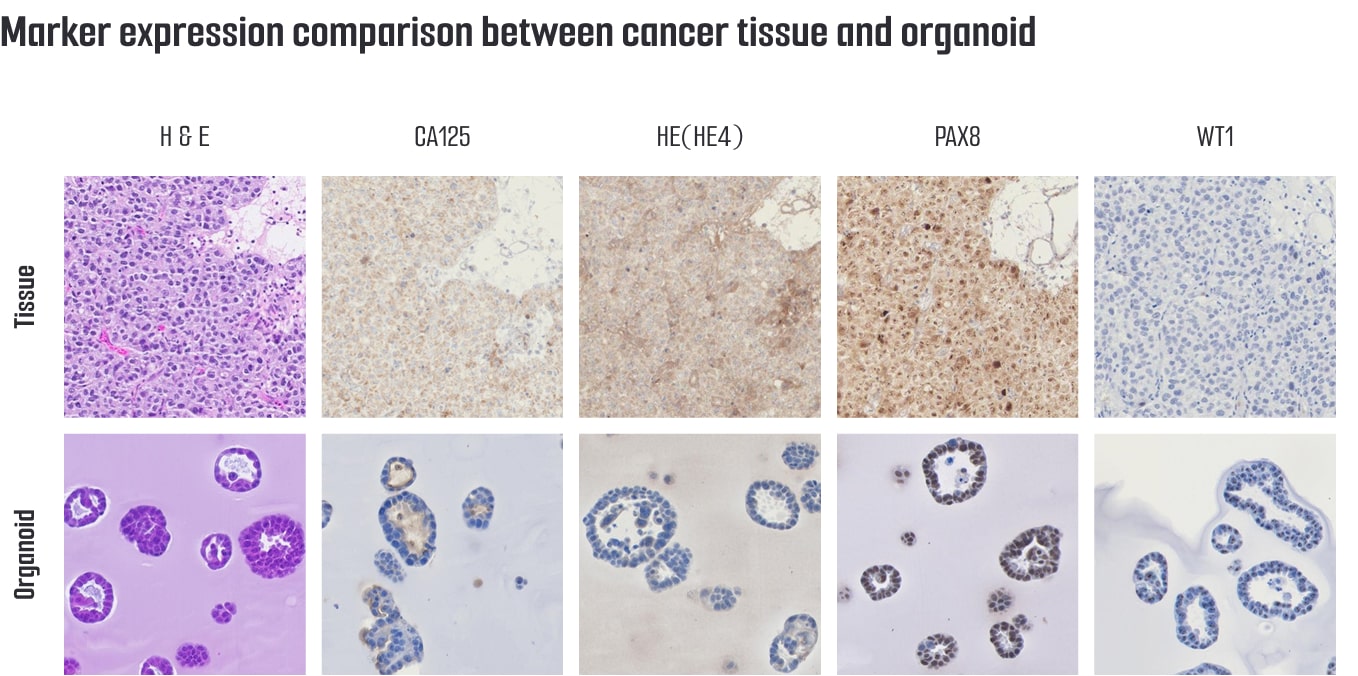
Importantly, ovarian cancer organoids can capture patient-specific heterogeneity and have demonstrated utility in:
- Drug sensitivity and resistance testing
- Evaluation of targeted therapies and antibody-drug conjugates
- Precision oncology research
- Biomarker discovery
- Mechanistic studies of platinum resistance
- Investigation of tumor evolution and recurrence
As platinum-resistant ovarian cancer remains a major unmet clinical challenge, organoid-based functional testing may provide researchers with valuable insights into why certain patients respond to therapies such as Elahere, relacorilant combinations, or immunotherapy while others do not.
By bridging the gap between conventional cell culture systems and patient tumors, ovarian cancer organoids offer a powerful translational tool for accelerating drug discovery and advancing precision medicine in ovarian cancer research.
Lambda Biologics’ Ovarian Cancer Organoid
- Ovarian cancer organoids are three-dimensional (3D) models that closely replicate the structure and cellular composition of actual cancer tissue.
- By preserving key characteristics of ovarian cancer, including genetic mutations and protein expression patterns, these organoids serve as reliable models for cancer research.
- Their ability to maintain tumor heterogeneity and accurately mimic the tumor microenvironment (TME) makes them invaluable for studying disease progression and treatment responses.
- As physiologically relevant models, ovarian cancer organoids play a crucial role in advancing precision medicine and facilitating the development of more effective cancer therapies.