A human skin organoid model that shows how stress drives hair greying by disrupting pigment-producing cells.
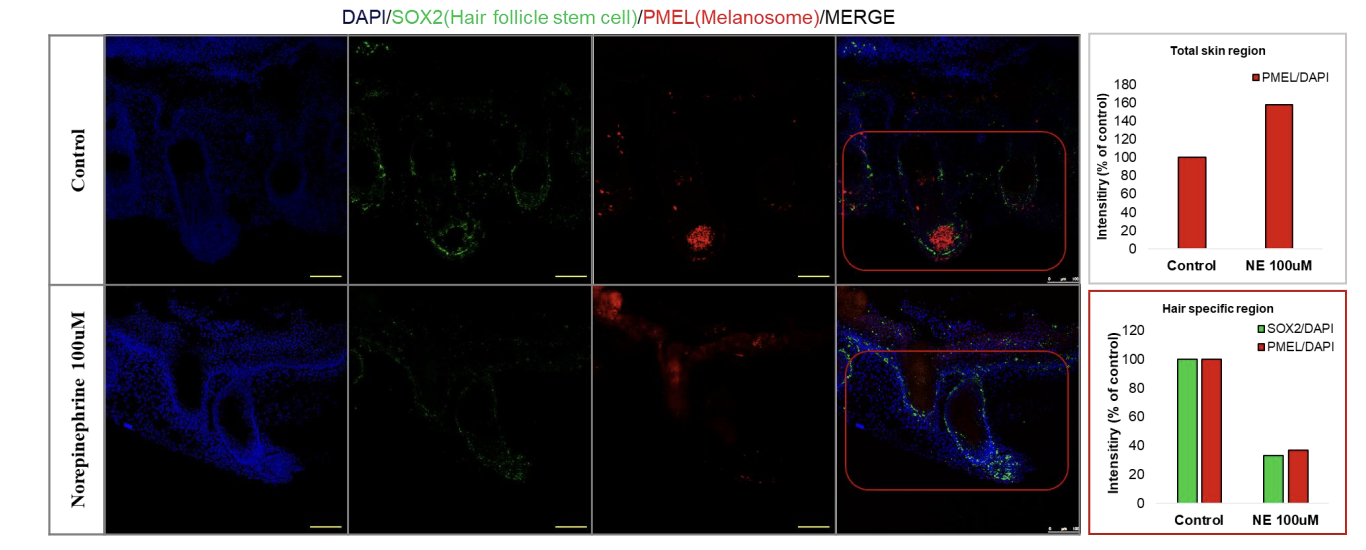
Stress stimulation leads to the gradual loss of melanocyte stem cells and mature melanocytes, reducing melanin production and resulting in gray or white hair – closely mirroring stress-induced hair greying in humans.
The skin is a highly complex organ that integrates barrier function, pigmentation, and hair follicle biology in response to environmental and psychological stress. However, understanding stress-induced hair greying remains challenging, as most existing models fail to capture the human-specific interactions between stress signals and pigment-producing cells within hair follicles.
Mouse skin differs significantly from human skin in hair cycle regulation, pigmentation, and stress responses, limiting translatability.
Many artificial skin models lack functional hair follicles, melanocyte stem cells, and sebaceous units – key structures involved in hair pigmentation.
Current models struggle to reproduce how psychological and physiological stress directly affects melanocyte survival and melanin production.
Few systems can connect stress-driven depletion of pigment-producing cells with the progressive emergence of gray or white hair phenotypes.
To address these challenges, we developed human skin organoids with functional hair follicles, based on well-established hPSC-derived organoid protocols. This platform preserves key cellular interactions involved in hair pigmentation, enabling the study of stress responses in a human-relevant context.
In collaboration with OrganoidSciences, we established a stress-induced hair greying model that reproduces the progressive loss of pigment-producing cells and reduced melanin production observed in humans.
The scientific relevance of this model was recognised internationally when it received the 2025 IFSCC Basic Research Award, for revealing molecular mechanisms underlying stress-induced hair greying using this organoid system.
Step 1: Human Hair Follicle Organoid Generation
Human skin organoids were generated from hPSC-derived protocols and further differentiated into hair follicle organoids (HFOs) using the Organoid Culture System, in collaboration with OrganoidSciences.
Step 2. Stress-Induced Pigmentation Loss
Stress pathways were activated using norepinephrine to model stress-driven melanocyte depletion and reduced melanin production across defined concentrations and time windows.
Step 3: Stage-Specific Stress Exposure
HFOs were treated at key stages of hair development to model progressive greying:
DIV40: pre–hair bulb formation
DIV70: hair bulb emergence
DIV85: mature hair follicle formation
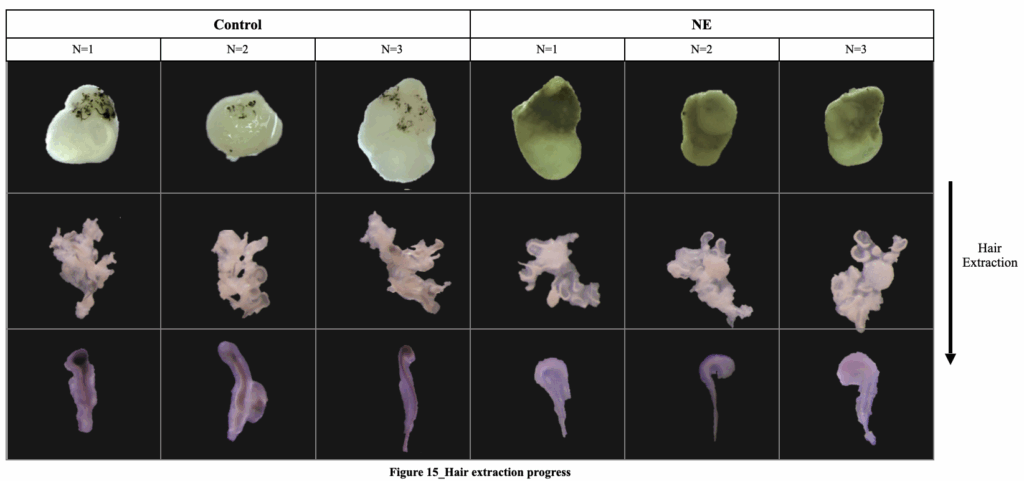
Step 4: Pigmentation Readout & Analysis
Hair shaft pigmentation was quantified using image-based analysis (ImageJ), linking cellular changes to visible gray/white hair phenotypes.