A breakthrough brain – computer interface (BCI) developed by Columbia University and collaborators is redefining what seamless, high-bandwidth communication between the brain and machines could look like. The new system, called BISC (Biological Interface System to Cortex), is an ultra-thin, paper-like silicon implant that rests gently on the brain’s surface and wirelessly transmits neural activity at unprecedented speed.
Unlike traditional BCIs that rely on bulky implanted electronics and skull-mounted hardware, BISC is built on a single, flexible silicon chip – thinner than a sheet of paper and only 3 mm³ in volume. Despite its tiny size, it contains more than 65,000 electrodes and thousands of recording and stimulation channels. The implant pairs with an external wearable “relay station” that powers the device and streams data over an ultrawideband wireless link reaching 100 Mbps, at least 100× faster than current wireless BCIs.
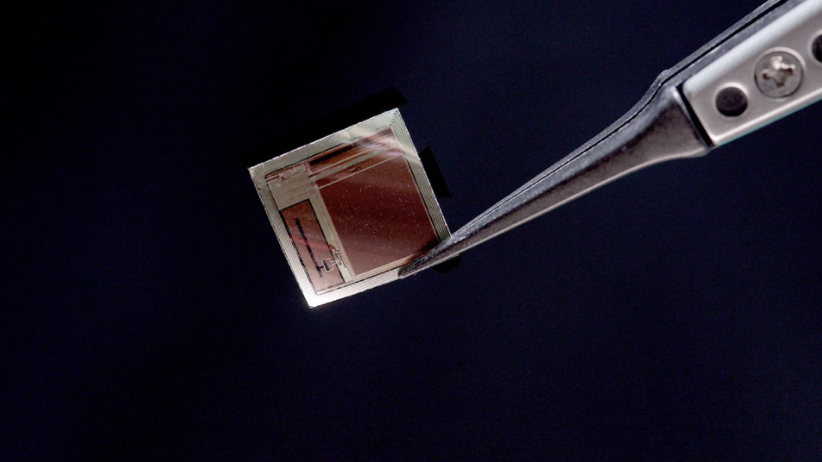
The BISC implant shown here is roughly as thick as a human hair. Credit: Columbia Engineering; ScienceDaily
Early clinical studies show that BISC can be inserted through a small skull opening and remain stable while capturing rich, high-resolution neural signals. Its minimally invasive design avoids penetrating electrodes and reduces tissue reactivity, allowing for long-term, high-quality recordings.
BISC’s real impact lies in its ability to decode movement, perception, and intent in real time, enabling advanced AI models to interpret brain activity. This opens exciting possibilities for treating epilepsy, paralysis, ALS, stroke, and vision loss – while laying the groundwork for adaptive neuroprosthetics and future brain – AI communication.
Developed with support from DARPA and now being commercialized through the startup Kampto Neurotech, BISC represents a fundamentally new class of neural interface: smaller, safer, more powerful, and ready to scale. As computing and AI continue to advance, this technology brings us closer to a future where the brain and machines can interact fluidly – restoring lost abilities and potentially augmenting human capabilities.
Research article: Scientists reveal a tiny brain chip that streams thoughts in real time
Unlocking Human Insight with Organoid Models
Cerebral Organoid | Midbrain Organoid | Skin & Hair Organoid | Intestine Organoid | Gastric Cancer Organoid | Breast Cancer Organoid | Hepatocarcinoma Cancer Organoid | Pancreatic Cancer Organoid