Hair research plays a critical role in addressing widespread conditions such as androgenetic alopecia, hair thinning, and hair graying. Despite decades of investigation, progress in developing effective treatments has been slow – largely due to limitations in existing research models. Traditional systems often fail to accurately replicate the complexity of human hair follicle biology.
Recent advances in human skin organoid models are reshaping this landscape. By providing a three-dimensional, human-relevant platform that recapitulates key aspects of skin and hair follicle development, skin organoids enable deeper insight into hair growth, loss, and regeneration mechanisms.
Ready to improve your hair research? Explore Lambda Biologics’ skin organoid solutions
Overview of Hair Research Models
Limitations of Conventional Approaches
For many years, hair biology research has relied on a combination of in vitro and in vivo models, each with notable drawbacks:
Research Model | Key Limitations |
|---|---|
2D cell cultures | Lack 3D architecture and fail to reproduce epithelial–mesenchymal interactions essential for hair follicle formation |
Animal models | Rodent hair differs significantly from human hair in structure, cycling dynamics, and treatment response |
Ex vivo human follicles | Limited viability (days to weeks), preventing long-term studies of hair growth cycles |
These limitations contribute to poor translation of preclinical findings into effective human therapies, particularly for chronic conditions such as androgenetic alopecia.
Skin Organoids: A New Approach to Hair Research
What Are Skin Organoids?
Skin organoids are three-dimensional, self-organizing tissue models derived from human pluripotent stem cells (hPSCs), including embryonic stem cells (hESCs) and induced pluripotent stem cells (iPSCs). Under defined culture conditions, these cells differentiate into complex skin-like tissues containing:
- Stratified epidermis and dermis
- Hair follicles with associated structures
- Sebaceous glands
- Melanocyte populations
- Sensory neuron components
Unlike simplified co-culture systems, skin organoids recapitulate multiple interacting cell types within a physiologically relevant architecture.
Development of Hair-Bearing Skin Organoids
During differentiation, skin organoids follow a developmental trajectory comparable to early human skin formation:
- ~55–75 days: Hair placodes and early follicular structures emerge
- ~60–90+ days: Maturing hair follicles become visible
- ~130 days: Organoids reach advanced complexity, exhibiting pigmented hair follicles, sebaceous glands, and stratified skin layers
These models can be maintained for up to ~150 days, enabling studies that extend well beyond the lifespan of ex vivo follicle cultures.


Image: Generation process of mature human skin organoid
Applications of Human Skin Organoids in Hair Research
Hair Follicle Formation and Morphogenesis
Skin organoids provide a unique platform to study human hair follicle development from early specification to maturation. Researchers can investigate signaling pathways, epithelial–mesenchymal interactions, and structural organization involved in follicle morphogenesis – processes that are difficult to model accurately using conventional systems.
Read more: Spatially Resolved Proteomic Mapping in Skin Organoid for Hair Follicle Development
Hair Loss and Androgenetic Alopecia Research
Androgenetic alopecia is characterized by progressive follicle miniaturization driven by androgen signaling. Skin organoid-based models enable:
- Direct investigation of follicle responses to hormonal or signaling perturbations
- Evaluation of candidate compounds for their effects on follicle structure and growth
- Exploration of disease mechanisms in a human cellular context
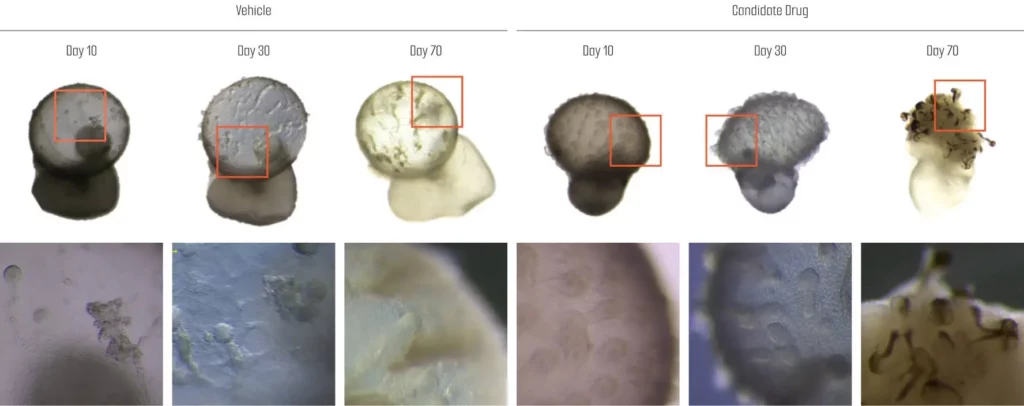
Image: Hair formation efficacy test in the skin organoids
Organoids derived from donor-specific or genetically defined cells further support research into inter-individual variability in hair loss susceptibility and treatment response.
Hair Growth Cycle Studies
Human hair follicles undergo a cyclical process of growth (anagen), regression (catagen), and rest (telogen) over extended timeframes. The long-term culture capability of skin organoids enables investigation of molecular regulators governing these transitions – an area largely inaccessible using short-lived ex vivo models.
Understanding how follicles enter, exit, or remain in specific phases is central to developing therapies aimed at reactivating hair growth.
Hair Graying and Pigmentation Research
Discover the IFSCC award-winning model advancing hair greying research
Hair graying is associated with dysfunction or depletion of melanocyte stem cells within hair follicles. Skin organoids containing pigmented follicles and melanocyte populations offer a controlled system to study:
- Melanocyte development and maintenance
- Responses to stress or aging-related signals
- Mechanisms underlying pigmentation loss
These applications are particularly relevant for cosmetic research and aging biology.
Advantages of Skin Organoid–Based Hair Research Models
Human Relevance: Derived from human cells, skin organoids capture species-specific features of skin and hair biology, improving predictive value over animal models.
Complex Tissue Architecture: Organoids self-organize into multilayered skin structures with multiple interacting cell types, closely resembling in vivo microenvironments.
Extended Study Duration: Maintenance for up to ~150 days allows investigation of long-term biological processes, chronic exposure effects, and hair cycle dynamics.
Scalability and Throughput: Organoid systems support parallelized experiments and compound screening, making them suitable for discovery-stage research.
Animal-Free Research: Skin organoids contribute to ethical, animal-free testing strategies while maintaining scientific rigor.
Lambda Biologics’ Skin Organoid Services for Hair Research
Lambda Biologics provides advanced human skin organoid platforms designed to support research in hair biology and dermatological science. The company’s models replicate key features of human skin and hair follicles, enabling mechanistic studies and compound evaluation in a human-relevant context.
Key Capabilities
- Validated skin and hair follicle organoid models
- Support for hair growth, hair loss, and pigmentation studies
- Scalable systems suitable for screening and pathway analysis
- Rigorous quality control and standardized characterization
These platforms are designed for preclinical research applications in pharmaceutical and cosmetic R&D.
Request a consultation to discuss your hair research needs
The Future of Hair Research
Skin organoid technology represents a significant step forward in hair biology research. By bridging the gap between oversimplified in vitro cultures and complex animal models, skin organoids provide a powerful, human-relevant system for studying hair development, loss, and aging.
As protocols continue to mature, skin organoid models are expected to play an increasingly central role in the discovery and evaluation of next-generation hair therapies.