Antibody-drug conjugates (ADCs) have emerged as one of the most exciting and rapidly advancing drug classes in oncology. By combining the targeting precision of monoclonal antibodies with the cytotoxic power of small-molecule payloads, ADCs offer a compelling approach to treating cancers that have proven difficult to address with conventional therapies.
But as the pipeline of ADC candidates grows – with over 200 ADCs currently in clinical trials – the pressure to make smarter preclinical decisions has never been greater. Choosing the wrong model early can mean wasted resources, misleading efficacy data, and costly late-stage failures.
At the heart of this challenge lies a fundamental question: which preclinical model best captures the complexity of human tumor biology? For decades, 2D cell lines have been the industry workhorse. But organoid technology is rapidly changing the landscape – offering a more physiologically relevant alternative that better reflects real tumor behavior.
In this article, we compare organoids and 2D cell lines across the key dimensions that matter most for ADC research, to help R&D teams and CROs make more informed model selection decisions.
Read more: What Are Antibody-Drug Conjugates (ADCs)? Organoid Platforms for ADC Research

In This Article
Two Models, One Critical Decision
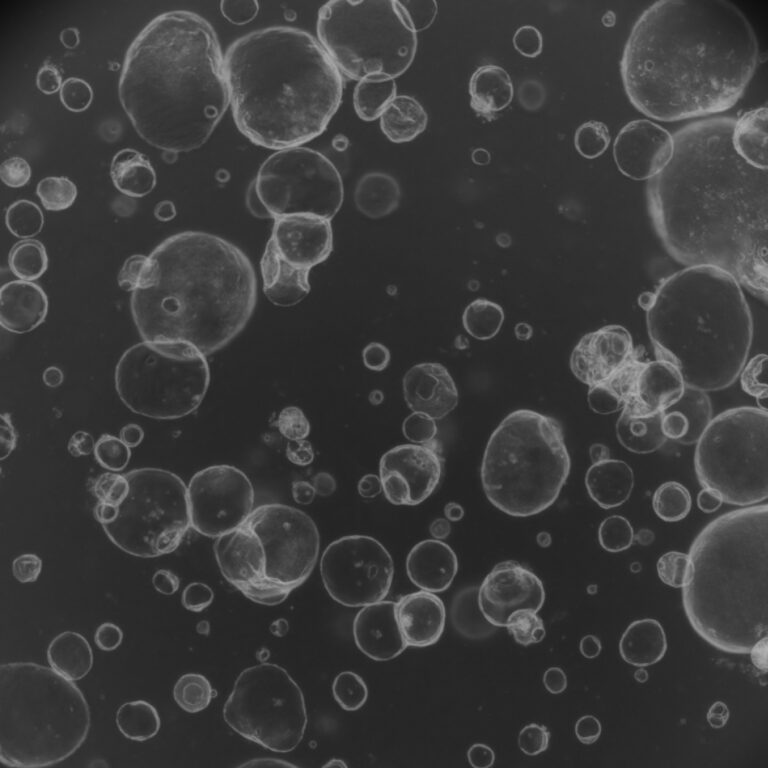
Most researchers in this space are well-acquainted with both systems. 2D cell lines – flat monolayer cultures grown on plastic – have been the industry standard for decades, valued for their accessibility, low cost, and reproducibility. Organoids, by contrast, are patient-derived 3D structures that self-organize to mimic the architecture and heterogeneity of real tumors.
The more pressing question for ADC programs isn’t what these models are – it’s when and why one outperforms the other. And increasingly, the data points in one direction.
Head-to-Head Comparison: Organoids vs. 2D Cell Lines
Factor | 2D Cell Lines | Organoids |
|---|---|---|
Antigen Expression | Altered – expression levels shift with passage number | ✅ Preserved – maintains native antigen density and distribution |
ADC Penetration Modeling | Limited – single layer does not replicate solid tumor barriers | ✅ Realistic – 3D architecture mimics drug diffusion barriers |
Toxicity Profiling | Basic – limited off-target signal | ✅ Comprehensive – better reflects in vivo toxicity profiles |
Tumor Microenvironment | Absent – flat monolayer lacks spatial complexity | ✅ Recapitulated – 3D structure models TME interactions |
Patient Relevance | Low – often derived from decades-old cell passages | ✅ High – patient-derived, preserves tumor heterogeneity |
Predictive Accuracy | Low – poor correlation with clinical outcomes | ✅ High – stronger translational validity |
Scalability | ✅ High – easy to scale for high-throughput screening | Moderate – requires specialized culture conditions |
Cost | ✅ Low – widely available, inexpensive | Higher – more resources needed for generation and maintenance |
Key Advantages of Organoids for ADC Research
When evaluated specifically for ADC development workflows, organoids offer several meaningful advantages:
1. Better Tumor Microenvironment (TME) Modeling
ADC efficacy is not just about hitting a target – it is deeply influenced by the tumor microenvironment. Factors such as interstitial pressure, stromal composition, and immune cell infiltration all affect how an ADC reaches its target and how efficiently the payload is released. Organoids recapitulate key elements of the TME that are entirely absent in 2D monolayers.
2. More Accurate Drug Penetration Assessment
Solid tumors present physical barriers to drug delivery. A 3D organoid structure creates realistic diffusion gradients that challenge an ADC in ways a flat monolayer simply cannot. This makes organoid-based penetration data far more predictive of in vivo behavior.
3. Higher Translational Validity
Patient-derived organoids preserve the genetic and phenotypic characteristics of the source tumor, including intratumoral heterogeneity. This means the efficacy data generated in organoid models has a stronger likelihood of translating into clinical outcomes – reducing the risk of late-stage failures.
4. More Reliable Antigen Expression Profiles
Target antigen expression – such as HER2, Trop-2, or HER3 – is central to ADC selectivity and efficacy. In passaged 2D cell lines, antigen levels often shift over time due to genetic drift. Patient-derived organoids maintain expression profiles that are far closer to native tissue, leading to more clinically relevant binding and internalization data.
5. Improved Off-Target Toxicity Profiling
One of the most persistent challenges in ADC development is managing off-target toxicity, particularly payload-related side effects. Organoid models – especially those derived from normal tissue – provide a more physiologically accurate picture of how an ADC affects healthy cells, enabling earlier and more reliable safety assessments.

Where 2D Cell Lines Still Have an Edge
Despite the advantages of organoids, 2D cell lines are not obsolete. They continue to offer practical benefits at specific stages of the ADC development process:
- Cost-effectiveness and scalability: 2D cell lines are significantly less expensive and easier to scale, making them well-suited for large-scale, high-throughput screening campaigns.
- Speed: Monolayer cultures are faster to establish and easier to work with, particularly for teams without dedicated organoid infrastructure.
- Established benchmarks: Decades of published data on specific cell lines allow teams to contextualize new findings against a broad historical dataset.
- Early-stage target validation: When the goal is simply to confirm that a target exists and is druggable, 2D models provide a quick and cost-efficient answer.
The key is knowing when each model is appropriate – and not defaulting to 2D simply out of habit.
Which Model Should You Choose?
The most effective ADC programs do not rely on a single model – they use a tiered strategy that leverages the strengths of each system at the right stage:
- Early Discovery & High-Throughput Screening: 2D cell lines for speed, scalability, and target validation
- Lead Optimization & Efficacy Validation: Organoids for improved physiological relevance and 3D tumor architecture
- Payload Evaluation & Functional Release Assessment: Organoids to evaluate tissue penetration and downstream cytotoxic effects (complemented by biochemical and PK studies for linker stability)
- Toxicity & Safety Profiling: Organoids (including normal tissue-derived systems) to assess on-target/off-tumor toxicity
- Translational Readout: Patient-derived organoids to generate clinically relevant, patient-specific response data
- Preclinical Confirmation: In vivo models for systemic pharmacokinetics, biodistribution, and whole-body safety
By integrating organoids at key inflection points, R&D teams can significantly improve the predictive power of their preclinical data – without sacrificing the speed and simplicity of 2D models in early-stage screening.
Lambda Biologics: Your Partner for Organoid-Based ADC Research
Antibody-drug conjugate (ADC) development demands models that better capture tumor complexity – beyond conventional cell lines.
Our ODISEI ONC platform is built on patient-derived organoids that preserve native tumor heterogeneity, with the ability to incorporate stromal and immune components in advanced co-culture systems to more closely reflect the in vivo tumor microenvironment.
From profiling antigen expression across tumor subtypes to evaluating functional payload activity and enabling translational efficacy studies, Lambda Biologics provides the scientific depth and infrastructure to support ADC programs across critical stages of preclinical development.
Conclusion
The question is not whether organoids will replace 2D cell lines in ADC research – it is how quickly the field will recognize that the two models serve fundamentally different purposes.
For teams developing antibody-drug conjugates, the physiological complexity of organoids directly addresses the core challenges of ADC research: accurate target engagement, realistic drug penetration, preserved antigen expression, and clinically relevant toxicity profiling.
As the ADC pipeline continues to grow and the bar for preclinical data quality rises, organoid-based models are quickly becoming not just an advantage – but a necessity.
Research article: Antibody–Drug Conjugates (ADCs): current and future biopharmaceuticals
Lambda Biologics’ Oncology Solutions: Patient-derived cancer organoid-based drug evaluation service
Gastric Cancer Organoid | Breast Cancer Organoid | Hepatocarcinoma Cancer Organoid | Pancreatic Cancer Organoid