High-Content Organoid Screening Identifies Regulators of Human Pancreatic Acinar Differentiation
Journal: Cell Stem Cell
Author: Keshara, Rashmiparvathi et al.
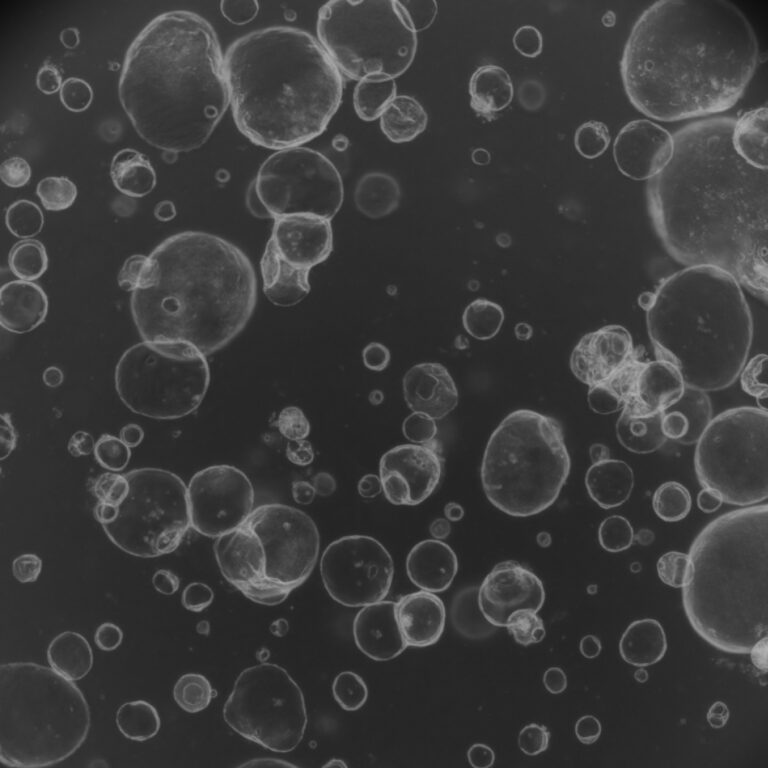
Using a high-content, image-based screening approach robust to organoid heterogeneity, the study identified 54 compounds that alter pancreatic progenitor organoid morphology or cell identity. In particular, GSK3A/B inhibition via WNT signaling reversibly shifts progenitors toward an acinar-primed state, and combined with FGF repression, drives functional pancreatic acinar differentiation relevant to exocrine biology and cancer research.
Loop-Connected Cerebral Organoids Enable Complex and Entrainable Neural Network Dynamics
Journal: Communications Biology
Author: Duenki, T., Ikeuchi, Y., Japan
The study introduces loop cerebral connectoids, modular networks of multiple cerebral organoids connected by axon bundles via microfluidic devices, to overcome limitations of single-organoid neural complexity. Larger connectoid networks display richer, more brain-like dynamics – including critical-state activity, pharmacologically relevant responses, and sequence-specific optogenetic entrainment – highlighting their potential for studying neuronal network function and disease mechanisms in vitro.
Segmentation Errors Significantly Distort Spatial Transcriptomics Analyses
Journal: Nature Genetics
Author: Mitchel, J., Gao, T., Petukhov, V. et al., USA
This study shows that cell segmentation errors in imaging-based spatial transcriptomics frequently misassign molecules, severely confounding downstream analyses such as differential expression, cell-cell interactions, and ligand – receptor inference. By applying matrix factorization to local molecular neighborhoods, the authors introduce an effective strategy to detect and correct molecular admixtures, improving the reliability of spatial transcriptomics data interpretation.
Mobility-Based Synthetic Contact Matrices Enable Robust Real-Time Epidemic Modeling
Journal: Nature Communications
Author: Di Domenico, L., Bosetti, P., Sabbatini, C.E. et al., Belgium, France
By comparing synthetic mobility-derived and empirical survey-based contact matrices in France during COVID-19, the study shows that both capture similar temporal contact trends, but synthetic matrices better reproduce hospitalization dynamics across most age groups. Their frequent updates and scalability make synthetic contact matrices a flexible and cost-effective tool for real-time pandemic modeling, while underscoring persistent challenges in accurately capturing children’s disease-relevant contacts.