

SAVE UPTO 30% ON ORGANOID SERVICES & ASSAYS - Offer end 28 February 2026
Home » Latest Research Trends » Organoid » Lab-Grown Human Spinal Cord Model Reveals Promising Regenerative Therapy

Lab-Grown Human Spinal Cord Model Reveals Promising Regenerative Therapy

Researchers at Northwestern University have developed an advanced human spinal cord organoid capable of realistically modeling traumatic spinal cord injury, marking a major step forward in regenerative medicine. Built from induced pluripotent stem cells, the mini spinal cords replicate key features of real injuries, including cell death, inflammation, and glial scar formation. Notably, the team incorporated microglia – immune cells of the central nervous system – creating a more accurate representation of post-injury inflammatory responses.

Lab-Grown Human Spinal Cord Model Reveals Promising Regenerative Therapy
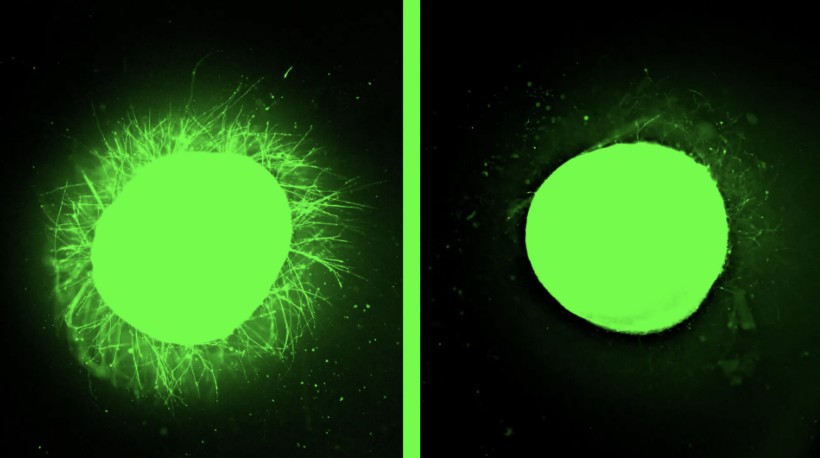
ScienceDaily; Fluorescent micrographs showing increased neurite outgrowth from a human spinal cord organoid treated with fast-moving “dancing molecules” (left) compared to one treated with slow-moving molecules (right) containing the same bioactive signals. Credit: Samuel I. Stupp/Northwestern University

Using this model, scientists tested an experimental treatment known as “dancing molecules,” a class of supramolecular therapeutic peptides designed to stimulate tissue repair through dynamic molecular motion. After treatment, damaged organoids showed significant neurite regrowth and a marked reduction in scar tissue. These results mirror previous animal studies in which a single injection restored mobility in paralyzed mice.

Recently granted Orphan Drug Designation by the U.S. Food and Drug Administration, the therapy shows potential for future human application. Published in Nature Biomedical Engineering, the study highlights how human organoids can accelerate translational research and bridge the gap between animal models and clinical trials.

Research article:


Lambda Biologics’ Oncology Solutions: Patient-derived cancer organoid-based drug evaluation service 

Gastric Cancer Organoid | Breast Cancer Organoid | Hepatocarcinoma Cancer Organoid | Pancreatic Cancer Organoid

>> See more 

Subscribe
to the latest updates in the newsletter

Related Solutions

  • Disease Modeling
  • Oncology
  • Organoid
  • Cosmetics
  • OECD TG
  • Zebrafish
  • Bioinfomatics
  • Live&3D Imaging
  • Molecular biology
  • Spatial Biology
Technical Service

Next Articles

There are no further posts.

Thank you for your insterest

You can now download the file.

Connect with Us