Home » AFS » MDSC-targeted Platform
Tumor Microenvironment

MDSC-targeted Platform

MDSC-targeted Platform

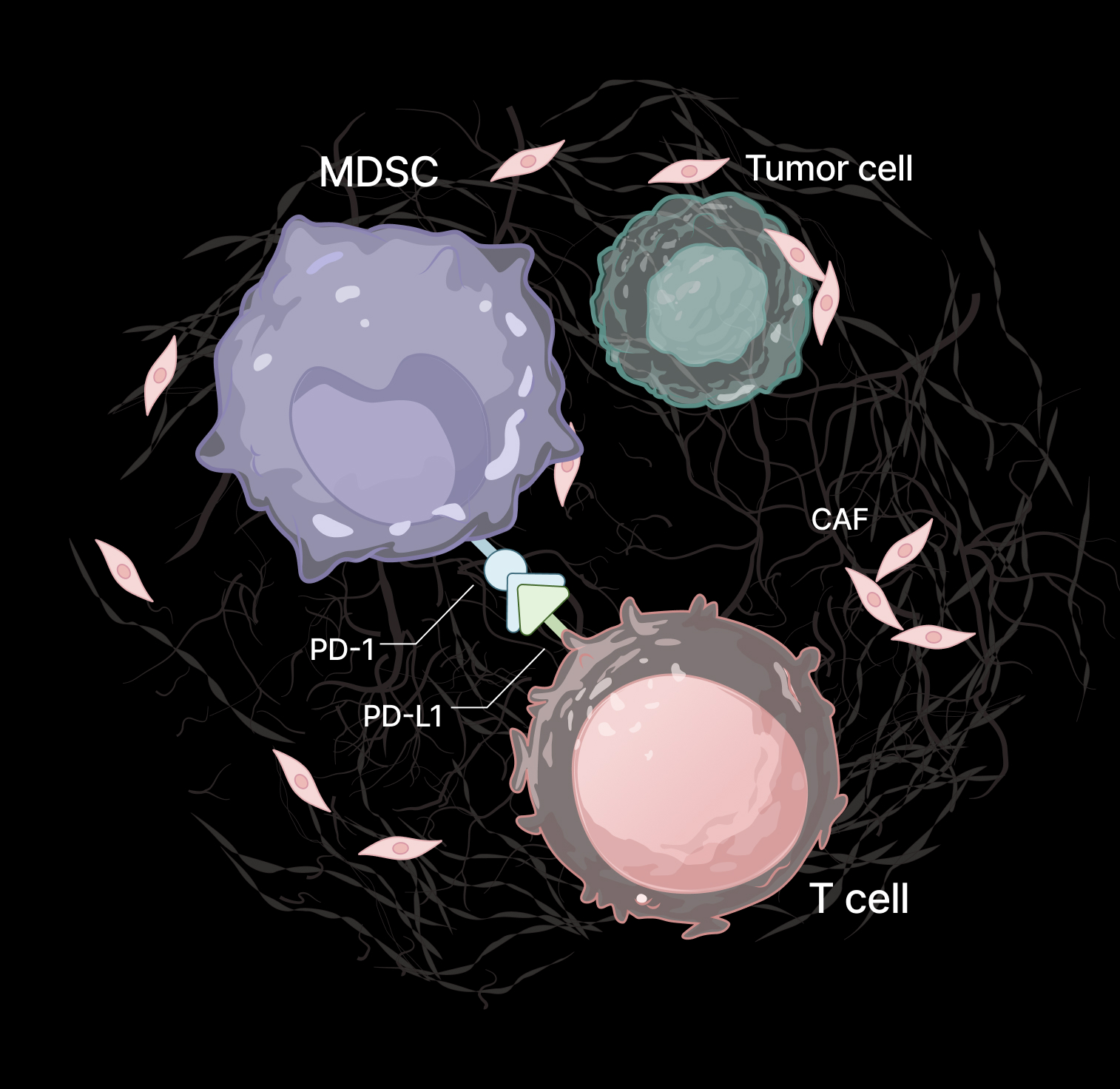
  • Myeloid-derived suppressor cells (MDSCs) are key drivers of immunosuppression and therapy resistance in cancer, actively shaping the tumor microenvironment (TME) by suppressing T-cell function and promoting tumor progression. Their accumulation and trafficking into tumors are tightly regulated by tumor- and stroma-derived signals, particularly from cancer-associated fibroblasts (CAFs).
  • Myeloid-derived suppressor cells (MDSCs) are key drivers of immunosuppression and therapy resistance in cancer, actively shaping the tumor microenvironment (TME) by suppressing T-cell function and promoting tumor progression. Their accumulation and trafficking into tumors are tightly regulated by tumor- and stroma-derived signals, particularly from cancer-associated fibroblasts (CAFs).

Price
Organism
Human
Product Type
Tumor Organoid + MDSC + CAF
Tissue
Disease

Applications

Cancer Organoid

Colorectal Cancer

Non-Small Cell Lung Cancer

Pancreatic Cancer

Breast Cancer

Cancer Organoid

Cholangiocarcinoma

Gastric Cancer

Ovarian Cancer

Professor Lee Chang-seok Eulji University
Customer insight

Advancing K-Beauty with Skin Organoids: A Next-Generation Platform for Non-Animal Testing and High-Precision Cosmetic Innovation

With the global rise of K-beauty, the cosmetics industry continues to grow steadily. Since the ban on animal testing for cosmetics in Korea in 2017, various alternative testing methods have...

Tomocube (Spatial)
Customer insight

HT-X1: A Label-Free Imaging Breakthrough for Organoid-Based Disease Modeling and Drug Screening

Traditional microscopy methods often require fluorescent labeling to analyze cellular structures, which can be time-consuming and invasive. In contrast, our HT-X1 system allows for high-resolution visualization of cellular morphology without...

Seoul National University College of Medicine
Customer insight

Pioneering Spatial Protein Analysis in Korea: Advancing Clinical Pathology with Lambda Biologics’ Support

Traditional protein analysis has primarily focused on quantifying expression levels within tissue samples. However, recent advances in spatial analysis techniques have shifted attention toward evaluating not only expression levels, but...

K Research Institute
Customer insight

ODISEI-Gut Platform Reveals Immune-Boosting Potential of Kimchi-Derived Bacterial Strain

Among the many fermented foods we consume, kimchi is particularly known for containing a diverse range of lactic acid bacteria, which are believed to influence the activation of immune cells...

Bundang Jesaeng General Hospital
Customer insight

Multiplex Marker Analysis Enhances Research Efficiency with 31-Marker Detection on a Single Slide

We conducted a study focused on identifying disease-related markers using patient-derived tissue samples. However, traditional methods limited our ability to analyze multiple candidate markers simultaneously, and the limited availability of...

Description

Principle

Chemotactic recruitment of MDSCs
MDSCs migrate toward tumor-derived signals and infiltrate tumor tissues through extracellular matrix barriers. The Transwell system models this process by enabling measurement of directional migration and invasion toward tumor organoids and CAFs.
Immunosuppressive Function
MDSCs suppress T-cell activation and clustering through both direct cell–cell interactions and soluble factors. Functional co-culture assays enable quantification of this immunosuppressive activity.
Multicellular crosstalk
The inclusion of both tumor organoids and CAFs enables modeling of synergistic signaling within the TME, which is critical for accurately reproducing MDSC recruitment dynamics.

Process

Generation and Phenotypic Validation of MDSC-like Cells
THP-1 cells are first differentiated under cytokine-driven conditions to generate MDSC-like cells. These cells are validated to exhibit an MDSC-consistent phenotype through flow cytometry and to express immune-regulatory gene signatures as confirmed by qRT–PCR, while remaining distinct from conventional macrophage differentiation states.
Functional Validation of Immunosuppressive Activity
Their immunosuppressive function is then assessed using PBMC and T-cell co-culture assays, where MDSC-like cells demonstrate the ability to suppress T-cell clustering through both contact-dependent interactions and soluble factor–mediated mechanisms.
Transwell Co-culture Setup
For the co-culture system, MDSC-like cells are seeded in the upper chamber of a Matrigel-coated Transwell insert with a 5 µm pore size, while colorectal cancer (CRC) organoids , CAFs, or their combination are placed in the lower chamber. This configuration enables the assessment of MDSC trafficking and infiltration under defined multicellular conditions.
Compound Treatment and Evaluation
Candidate compounds can be introduced into the system to evaluate their effects on MDSC behavior, including both direct cellular responses and changes in migration and infiltration within the co-culture setup.

Read out

MDSC immunosuppressive function is assessed through T-cell clustering assays, while trafficking and infiltration are quantitatively measured using imaging-based cell counting and flow cytometry (FACS), providing orthogonal and complementary readouts. The platform demonstrates that tumor organoids and CAFs contribute to MDSC infiltration dynamics, while MDSC-like cells exhibit robust immunosuppressive activity in co-culture systems.
In drug profiling studies, differential responses are observed across tumor organoids, MDSC-like cells, and CAFs, enabling evaluation of cell type–specific effects. Importantly, certain compounds reduce MDSC-mediated immunosuppression, while others modulate MDSC trafficking and infiltration in a concentration-dependent manner, highlighting distinct and complementary therapeutic strategies.

Implications for Drug Development

This MDSC-targeted Anticancer Drug Evaluation Platform (Infiltration) enables:
  • Mechanism-driven evaluation of MDSC-targeting therapies
  • Identification of agents that disrupt immune suppression via trafficking inhibition
  • More predictive assessment of drug efficacy in a human, multicellular tumor context
Ultimately, it supports the development of next-generation immunotherapies aimed at reprogramming the tumor microenvironment and overcoming resistance.


Thank you for your insterest

You can now download the file.

Connect with Us