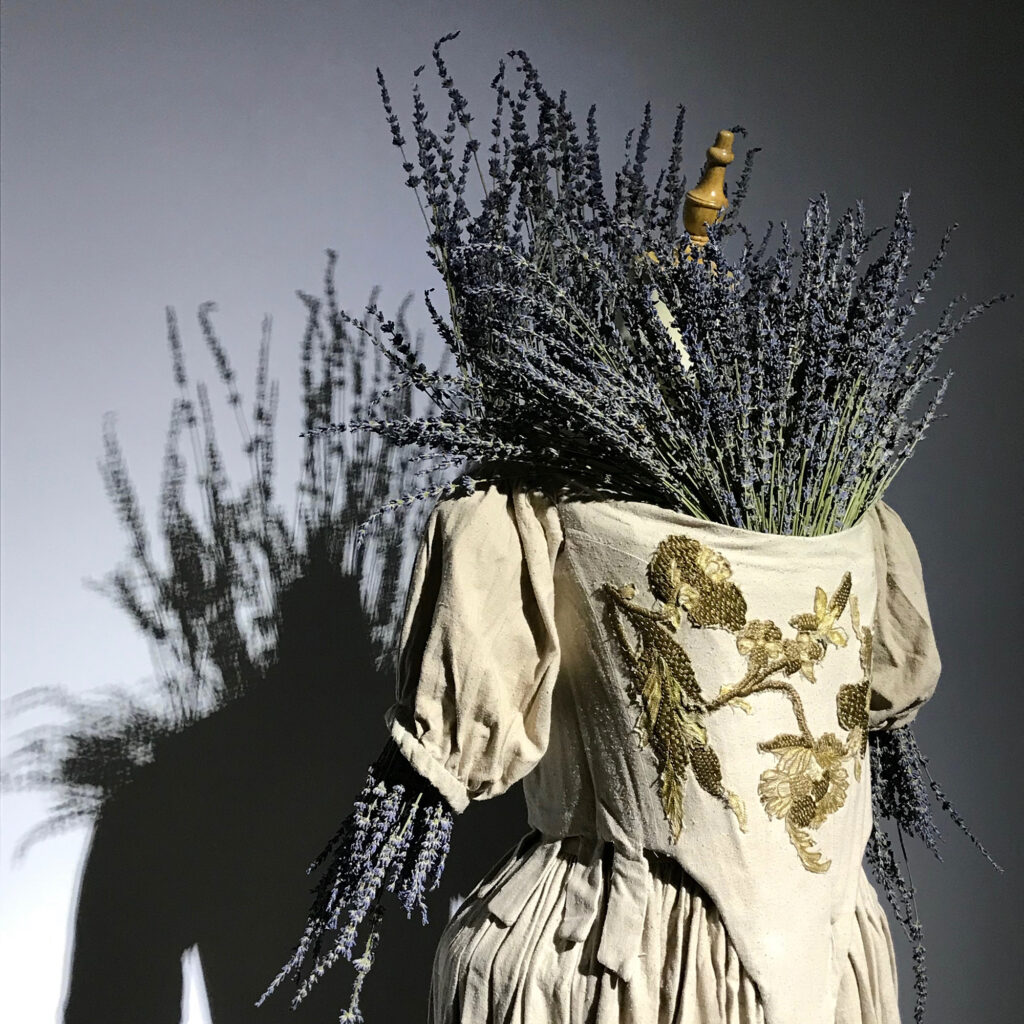
A dress carrying the story of the Black Death. Delicate embroidered textiles trace the unpredictable paths of mutation, inheritance, and microbial evolution. Scientific instruments, biological materials, and centuries of medical history are woven together into objects that feel at once familiar and unsettling.
They are not scientific illustrations, nor museum artifacts.
They are works of art.
In her recent solo exhibition, BioArt Transformations (2026), British artist Anna Dumitriu invites us to reconsider an assumption that has long separated the laboratory from the gallery: perhaps biology is not simply something we study. Perhaps it is also a medium through which we can tell stories about ourselves.
This is what makes Dumitriu one of the most distinctive figures in contemporary Bioart. While many artists draw inspiration from science, she works directly with its materials and methods, collaborating with microbiologists, geneticists, and synthetic biologists to create works that explore disease, identity, memory, and technological change.
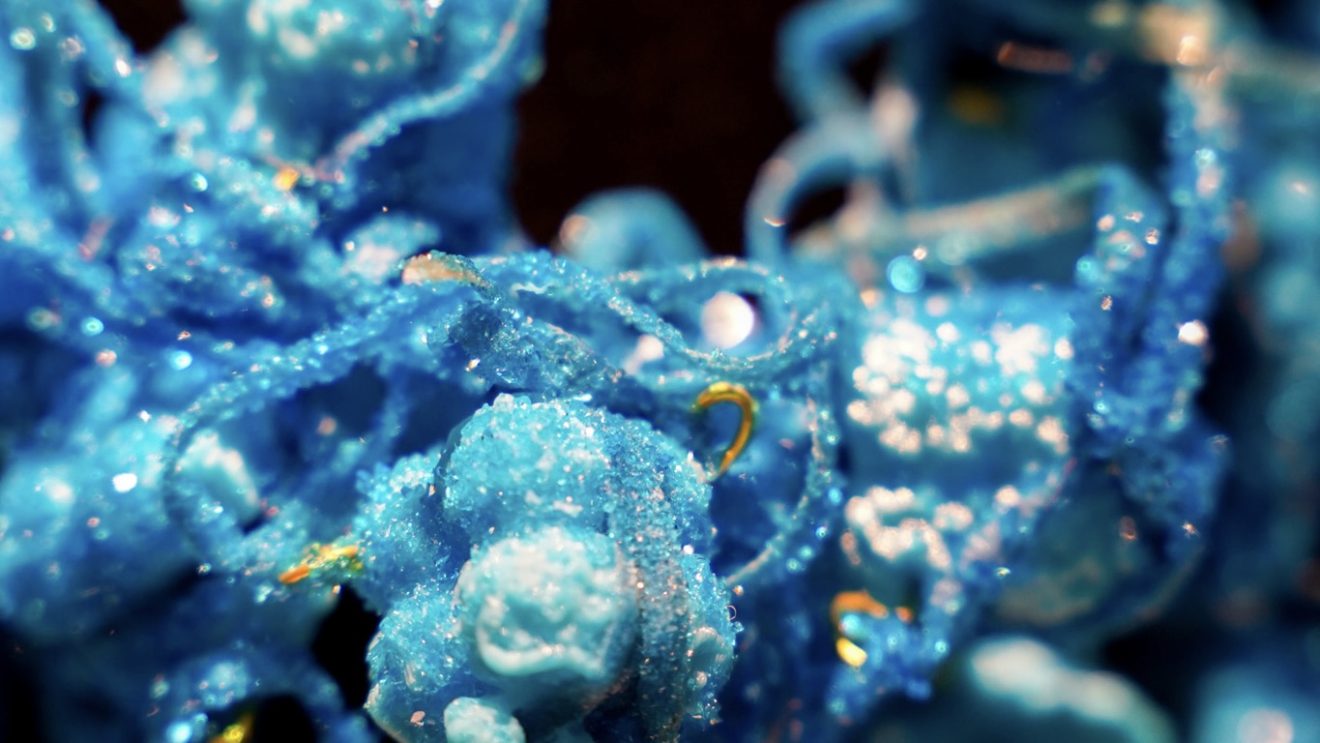
One of the exhibition’s most striking pieces is The Plague Dress, a work inspired by the bacterium Yersinia pestis, the pathogen responsible for the Black Death. Rather than treating the plague as a historical event, Dumitriu transforms it into a physical and cultural object. The piece combines traditional craftsmanship with biological research, collapsing the distance between scientific investigation and historical memory.
For centuries, societies have remembered pandemics through paintings, literature, and written records. Dumitriu remembers them through the biology itself.
Another work, The Mutability of Memories and Fates, a part of the upcoming exhibition “In Formation” at Muffatwerk in Munich, opening on 5 July 2026 explores the idea that mutation is more than a molecular event. Through intricate textile techniques informed by genetics and microbiology, the piece reflects on inheritance, uncertainty, and the ways biological change shapes not only individuals but entire cultures. The title itself captures a truth familiar to every geneticist: life is never static. It is an ongoing process of variation and adaptation.
Her broader body of work follows this same philosophy. Projects such as The Romantic Disease, which examined the cultural and biological history of tuberculosis, and Engineered Antibody, inspired by advances in modern immunotherapy, blur the boundaries between scientific research and artistic practice.
What Dumitriu’s exhibition ultimately reveals is not simply the creativity of one artist, but the remarkable transformation of biology itself.
For much of history, biology was a science of observation. Scientists collected specimens, classified organisms, and described the natural world. Today, biology has become something far more dynamic. We edit genes, engineer cells, cultivate organoids, and guide stem cells into becoming miniature models of human organs. Modern bioscience increasingly works with living systems rather than simply observing them.
Perhaps this is why Bioart feels especially relevant today.
A brain organoid grown from stem cells is, first and foremost, a scientific model. But it is also something else: an object that forces us to ask larger questions. What defines a biological self? Where does life begin and end? What responsibilities come with our growing ability to shape living matter?
Artists like Anna Dumitriu do not seek to answer these questions. They make them visible.
For scientists, this offers a perspective that is easy to overlook amid experiments and protocols. Research is often measured through data, reproducibility, and therapeutic outcomes. Yet anyone who has watched stem cells self-organize, organoids develop their intricate structures, or microbial colonies adapt to new environments knows there is something profoundly captivating about these processes.
The beauty is not added afterward. It is already there.
Scientists and artists have often been portrayed as working in different worlds. But in an age of regenerative medicine, synthetic biology, and cell engineering, that distinction feels increasingly artificial. Both are working with the same extraordinary material—life itself.
The difference is that one asks how it works, while the other asks what it means.
Perhaps that is the real significance of BioArt Transformations. It reminds us that bioscience is not only a discipline of discovery. It is also one of humanity’s richest forms of creative expression, revealing that the study of life can be every bit as moving, provocative, and beautiful as art itself.
Read more Bio, Sciences & Arts articles:
When Life Becomes the Canvas: Bioscience Is Transforming the Language of Art
In the Age of AI Slop, Biology Becomes the Last Authentic Medium